Relocation accommodation in Dubai is furnished, move-in-ready housing that bridges the gap between landing and signing a permanent lease. That gap is neither optional nor short. You cannot register a tenancy contract in Dubai without an Emirates ID, and the Emirates ID sits at the end of a visa chain that realistically takes four to eight weeks. Every relocating employee and every relocating family passes through that window, whether their company planned for it or not.
Dubai is absorbing this at scale. The emirate’s population reached 4.58 million at the end of 2025, up 7.5% in a single year, the fastest growth in its history. In 2025 alone, 71,830 new companies joined the Dubai Chamber of Commerce and 1,253 greenfield foreign investment projects landed, which ranked Dubai first globally for greenfield FDI projects for the fifth consecutive year. Behind every one of those numbers is somebody who needed somewhere to live before their paperwork cleared.
This guide covers the sequence in the order you will actually experience it: what you can book at each visa stage, what an annual lease genuinely costs on day one, how hotels compare with serviced apartments over 30, 60 and 90 days, how corporate relocation policies handle temporary housing, and what relocating with school-age children requires in 2026. Figures are dated and sourced throughout.
On this page
- What relocation accommodation in Dubai means
- The first 90 days: a realistic timeline
- Why you cannot sign a lease the week you land
- What an annual lease actually costs upfront
- Hotel vs serviced apartment vs lease over 30, 60 and 90 days
- What corporate relocation packages cover
- Structuring temporary housing in a mobility policy
- Relocating with family: schools, timing and catchment
- The employee visa process, step by step
- Where to live in Dubai when you relocate
- Driving licences, pets, banking and insurance
- Your 90-day relocation housing checklist
- Why book with estaie
- Frequently asked questions
What relocation accommodation in Dubai means
Relocation accommodation is furnished housing booked by the month rather than the night or the year. It comes with the furniture, the utilities, the internet and the cleaning already included in one monthly figure, and it requires nothing more than a passport to book. In Dubai it takes three forms: hotel apartments run by hotel brands, serviced apartments built for living rather than sleeping, and licensed furnished monthly rentals in ordinary residential buildings.
It exists because the alternatives fail relocating people in specific ways. A hotel room works for a week and becomes expensive and claustrophobic by week three, particularly with a family. An annual lease is not legally available to you until your residence paperwork is complete, and even once it is, it front-loads tens of thousands of dirhams in commission, deposits and furniture before you know whether you have chosen the right neighbourhood. Furnished monthly housing sits in the middle. Full home, no commitment, nothing to set up.
The mobility industry has recognised this for decades. A typical relocation package includes 30 to 90 days of temporary housing as standard, and in survey data on international assignments, corporate housing and suite hotels were each used by 67% of organisations, ahead of full-service hotels at 39%. The question for most companies is not whether to provide interim housing but how long, and how to buy it well.

The first 90 days: a realistic timeline
Here is the sequence, with what you can legally book at each point. This is the part that generic relocation guides skip, and it is the part that determines your housing decision.
| Stage | Typical timing | What is happening | Where you live |
| Pre-arrival | 2–4 weeks before | Work permit issued (MOHRE service time: 2 working days), entry permit issued, documents attested | Home country. Book your Dubai housing now, not on arrival |
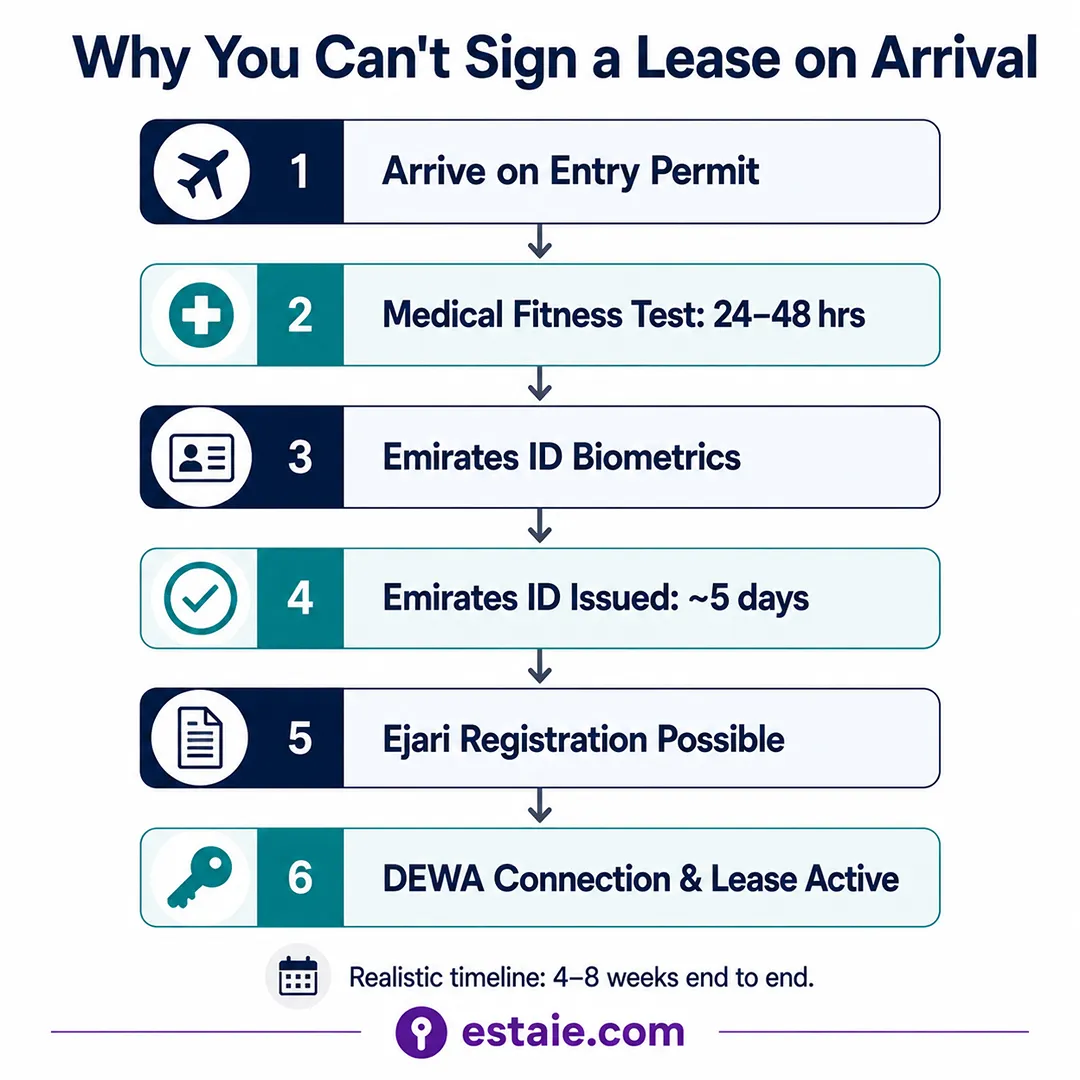
| Week 1 | Days 1–7 | Arrival on entry permit. Medical fitness test: 24 working hours standard, 6 hours express, 30 minutes at fast-track centres | Furnished monthly home or hotel apartment, passport only |
| Week 1–2 | Days 3–14 | Emirates ID application and in-person biometrics. ICP standard issuance: 5 days | Same |
| Week 2–4 | Days 10–28 | Residence permit stamping. GDRFA Dubai service time: 48 hours. Labour contract registered with MOHRE | Same |
| Week 4–8 | Days 28–56 | Emirates ID card in hand. Bank account opened. Cheque book issued | Still in furnished housing; you need the cheque book before most landlords will proceed |
| Week 6–12 | Days 42–90 | Property search, offer, Ejari registration, DEWA connection (within 15 working hours of deposit) | Move into permanent home |
Official service times from MOHRE, DHA, ICP, GDRFA Dubai and DEWA (DEWA move-in page updated 16 May 2026). End-to-end elapsed time of 2–4 weeks for the visa itself is consistent with industry guidance; the additional weeks are banking, search and negotiation.
Two honest caveats. Individual government service times add up to fewer than ten working days, and the real elapsed time comes from queuing, typing centre steps, courier legs and document attestation. Attestation is the single most common cause of delay. A foreign marriage or birth certificate must be attested by the issuing country’s foreign ministry, then by the UAE embassy there, then by UAE MOFAIC at AED 150 per document. The overseas legs can take weeks. Start them before the employee leaves home.
Practical planning number: book 60 days of furnished accommodation, with the option to extend monthly. Thirty days is optimistic for anyone who intends to lease. Ninety days is right for families, who are also searching schools.
Why you cannot sign a lease the week you land
Dubai’s rental system is built on Ejari, the Dubai Land Department register that gives a tenancy contract legal standing. Registering an Ejari contract requires the tenant to present a valid Emirates ID in person at a Real Estate Trustee Centre. The Emirates ID requires the residence visa process to be underway, including biometrics. And without an Ejari number, DEWA will not connect your electricity and water. DEWA’s own move-in service lists a valid Ejari number as a requirement for tenants.
There is a further loop that surprises people: the GDRFA document list for a residence entry permit for family members includes an attested tenancy contract and recent utility bills. So the visa process asks for a lease, and the lease process asks for the visa. In practice, immigration accepts other proof and families are sponsored successfully every day, but it explains why the sequence cannot simply be compressed.
Ejari also gates things beyond housing. You need it for fibre internet in your own name, for an RTA resident parking permit, and to file a case at the Rental Dispute Centre. Registration itself is cheap: AED 177.75 through the Dubai REST app or DLD website, AED 220 at a trustee centre, with a service time of about 25 minutes. It is the prerequisites, not the fee, that create the delay.
The legitimate route through this window is licensed short-term and serviced accommodation, which requires only a passport and payment. That is not a workaround; it is how the system expects new arrivals to be housed. It is also why corporate temporary-housing policies of 30 to 90 days exist in the first place.
What an annual lease actually costs upfront
The advertised rent is roughly half the story. A Dubai annual tenancy carries a stack of costs that arrive on day one, most of which do not exist in a monthly furnished booking.
| Cost | Amount | Refundable? |
| Agency commission | 5% of annual rent (minimum of around AED 5,000 commonly applies) | No |
| Security deposit | 5% of annual rent unfurnished, 10% furnished | Yes |
| Ejari registration | AED 177.75 via Dubai REST app / AED 220 at a trustee centre | No |
| DEWA security deposit | AED 2,000 apartment / AED 4,000 villa | Yes |
| DEWA activation | AED 125 small meter / AED 300 large meter | No |
| Chiller / district cooling deposit | AED 1,000–2,000 where the landlord does not cover it | Yes |
| Dubai Municipality housing fee | 5% of annual rent, billed in 12 instalments on your DEWA bill | No |
| Furniture | Highly variable; a full two-bedroom fit-out is a five-figure sum | No |
| Cheque premium | A 12-cheque payment plan can cost 6–10% more than a single cheque | No |
Dubai Land Department Ejari fees (page updated 9 July 2026); DEWA move-in service (updated 16 May 2026); Dubai Municipality housing fee applies to expatriate tenants and owners.
Worked example. Bayut’s H1 2026 rental report puts the average two-bedroom in Business Bay at AED 148,000 a year. Paid in four cheques, day-one cash comes to roughly AED 55,600: a first cheque of AED 37,000, AED 7,400 commission, AED 7,400 deposit, AED 220 Ejari, AED 2,125 DEWA and around AED 1,500 chiller deposit. About AED 10,900 of that is refundable, eventually. None of it includes a bed.
By contrast, a furnished monthly home is one payment, inclusive of utilities, internet and cleaning, with no commission, no Ejari, no DEWA account and no furniture. For a stay of under a year the arithmetic is not close. Independent modelling for a one-bedroom in Business Bay or Downtown puts the break-even against a conventional lease at around 14 months, with serviced apartments holding a 12–18% cost advantage below that point once furniture is counted. That is before any early-termination penalty, which in Dubai typically runs to about two months’ rent.
One piece of good news for 2026: Bayut characterises the first half of the year as a moderating rental market, with several segments up only 0.5–4% after several years of sharp increases. If you are timing a move, the market is friendlier than it was.
| Area (H1 2026 average annual rent) | Studio | 1-bed | 2-bed | 3-bed |
| International City | 41,000 | 61,000 | 82,000 | — |
| Al Nahda | 44,000 | 56,000 | 72,000 | — |
| Jumeirah Village Circle | 54,000 | 79,000 | 113,000 | — |
| Business Bay | 73,000 | 104,000 | 148,000 | — |
| Dubai Marina | — | 103,000 | 157,000 | 249,000 |
| Downtown Dubai | — | 133,000 | 223,000 | 362,000 |
| Palm Jumeirah | — | 169,000 | 249,000 | 382,000 |
AED per year. Bayut Dubai Rental Market Report H1 2026, published 16 July 2026. Villas: Mirdif 3-bed AED 142,000; Dubai Hills Estate 4-bed AED 359,000; Arabian Ranches 4-bed AED 404,000.
Hotel vs serviced apartment vs lease over 30, 60 and 90 days
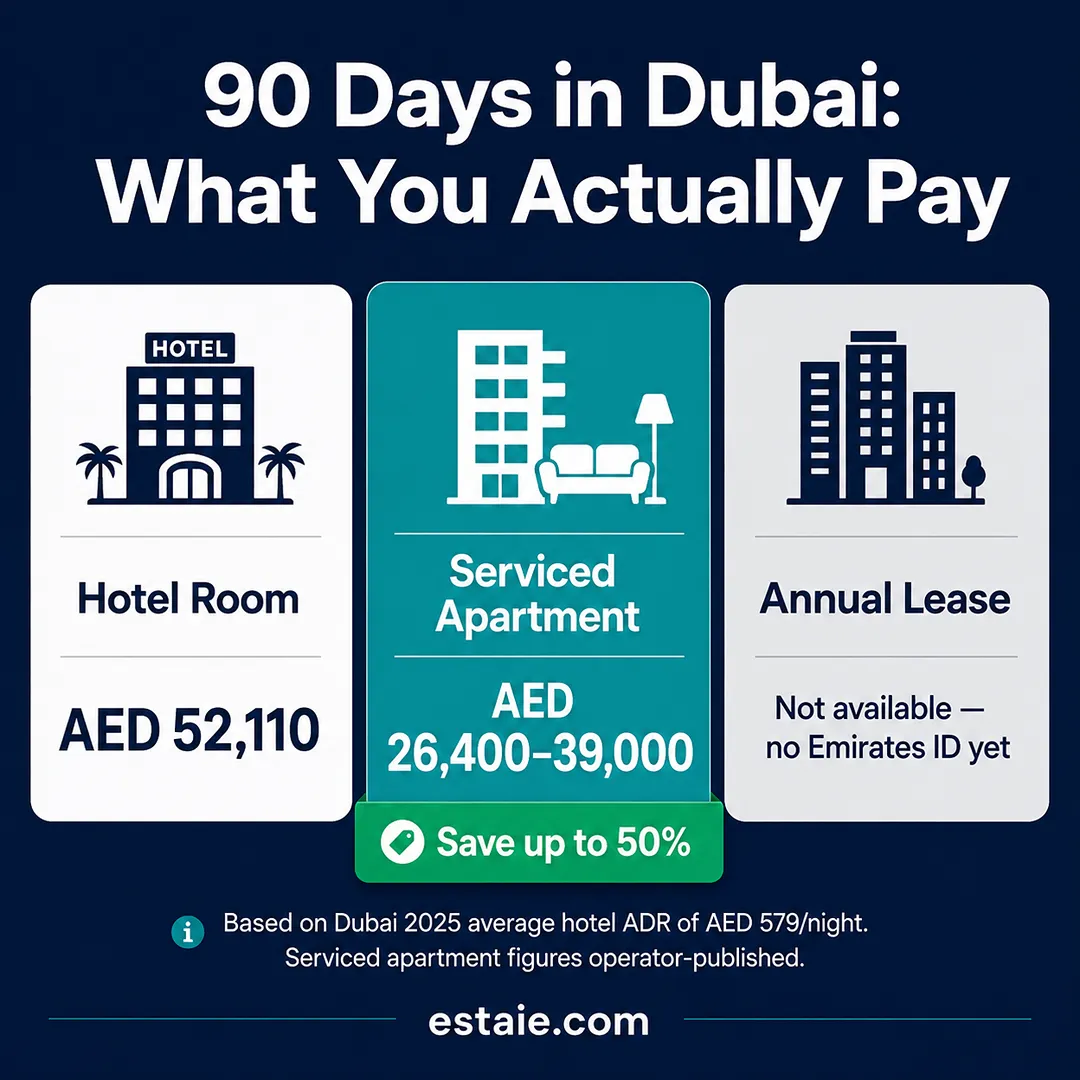
For a 90-day stay, a serviced apartment costs roughly a quarter to a half of what the same period costs in a hotel at Dubai’s average rate, and that is before the money a kitchen saves you on meals.
| Option | 30 days | 60 days | 90 days |
| Hotel at Dubai city-wide average daily rate (AED 579/night) | AED 17,370 | AED 34,740 | AED 52,110 |
| Budget long-stay hotel, monthly rate (low end) | AED 3,499 | AED 6,998 | AED 10,497 |
| Budget long-stay hotel, monthly rate (high end) | AED 5,999 | AED 11,998 | AED 17,997 |
| Serviced apartment, entry level | AED 8,800 | AED 17,600 | AED 26,400 |
| Serviced apartment, mid to upper | AED 13,000 | AED 26,000 | AED 39,000 |
Dubai’s 2025 city-wide hotel ADR was AED 579, up 8% on AED 538 in 2024, with 80.7% occupancy across 154,264 rooms — Dubai Department of Economy and Tourism, February 2026. Monthly hotel and serviced apartment rates are operator-published. Multiplication is ours.
Read that table with the space in mind, not just the price. A hotel room at AED 579 a night gives one room and no kitchen. A serviced apartment at AED 8,800 a month gives a separate living area, a full kitchen, a work surface and usually a washing machine, for half the cost of the hotel over the same 90 days. For a family of four the comparison stops being close, because a hotel means two connecting rooms and every meal eaten out.
This is also the strongest single argument to bring to a finance team. A 90-day interim housing budget of AED 26,400–39,000 per assignee, instead of AED 52,110 in hotels, is a 25–50% saving on a line item that most mobility policies already fund.
What corporate relocation packages cover
A standard international relocation package includes nine components: moving services, temporary housing, home sale assistance, home purchase support, relocation travel and house-hunting trips, destination services such as area orientation and school search, spousal career assistance, tax gross-up or equalisation, and pet and vehicle shipment. Temporary housing is typically provided for 30 to 90 days.
The cost context: an international move for a mid-level professional runs USD 40,000–90,000 or more, roughly two to three times the equivalent domestic move. A failed international assignment costs an estimated USD 1.25 million once compensation, relocation costs, ongoing support and taxes are counted, according to research conducted by Ipsos with KPMG across 255 senior decision-makers. Against that number, the marginal cost of an extra month of good interim housing is a rounding error.
Housing is far from a peripheral benefit. In a 2025 global mobility survey of more than 10,500 working professionals across 19 countries, 67% cited temporary housing support as a key relocation motivator, 76% said they would seek employer help finding temporary accommodation, 57% reported difficulty securing international housing, and 30% had declined a relocation outright because housing was unaffordable. Housing is the reason assignments get turned down.
Meanwhile the pressure on mobility budgets is real. In Cartus’s 2026 Global Talent Mobility Survey of 83 mobility, HR and people leaders, 70% were redesigning or restructuring policies to manage cost, rising mobility costs ranked in the top three challenges, and cost containment was the single most cited reason for reducing mobility activity. Worth noting for anyone assuming the industry has moved to cash: for global mobility, the survey ranked managed moves first, core/flex second and lump sum third.
Structuring temporary housing in a mobility policy
Three models dominate, and the right one depends on assignment length and seniority rather than on preference.
| Model | How it works | Best for | Watch out for |
| Direct-billed corporate housing | Company books and pays the provider; one monthly invoice per assignee | Volume moves, project teams, junior to mid-level | Requires a provider who can invoice a UAE entity properly and handle VAT |
| Managed budget | Company sets a cap and a preferred provider; employee chooses within it | Mid to senior individual moves | Cap set too low pushes people into hotels, which costs more |
| Lump sum | Employee receives cash and arranges their own housing | Short assignments, highly autonomous employees | Ranked third for global mobility in 2026; employees without local knowledge overpay or under-book |
Policy structures per Cartus Global Talent Mobility Survey 2026. Duration norms per CapRelo relocation package benchmarks, updated July 2026.
Four things separate a policy that works from one that generates escalations.
- Book 60 days minimum, with monthly extension. Thirty days does not survive contact with the Emirates ID timeline. Build the extension into the contract so nobody has to reapprove it.
- Match the unit to the family, not the grade. A single assignee in a studio and a family of four in a two-bedroom are different products. Grading interim housing purely by seniority produces waste at one end and complaints at the other.
- Locate against the destination, not the office. For families, the school run beats the commute. For project teams, proximity to the site beats prestige.
- Insist on all-inclusive rates. DEWA, chiller, internet and housekeeping inside one number makes the invoice auditable and removes an entire category of expense claims.
For teams of five or more, or for recurring project deployments, a dedicated corporate account with consolidated invoicing is usually cheaper and dramatically simpler than individual bookings. Our corporate housing Dubai guide covers rate cards, compliance and duty of care in detail.
Relocating with family: schools, timing and catchment
If you are moving with school-age children, the school decision sets the housing decision, not the other way round. Dubai’s academic year 2026-27 begins on Monday 31 August 2026, and admissions run on a long lead time.
The scale of the sector helps. Dubai had 233 private schools at the start of the 2025-26 year, alongside 331 early childhood centres, with 25 new institutions opening that year adding more than 11,700 school seats. Enrolment across the 2024-25 year was 387,441 students across 17 curricula and 185 nationalities. British curriculum holds roughly 37% of the market, Indian 26%, American 14% and IB 7%.
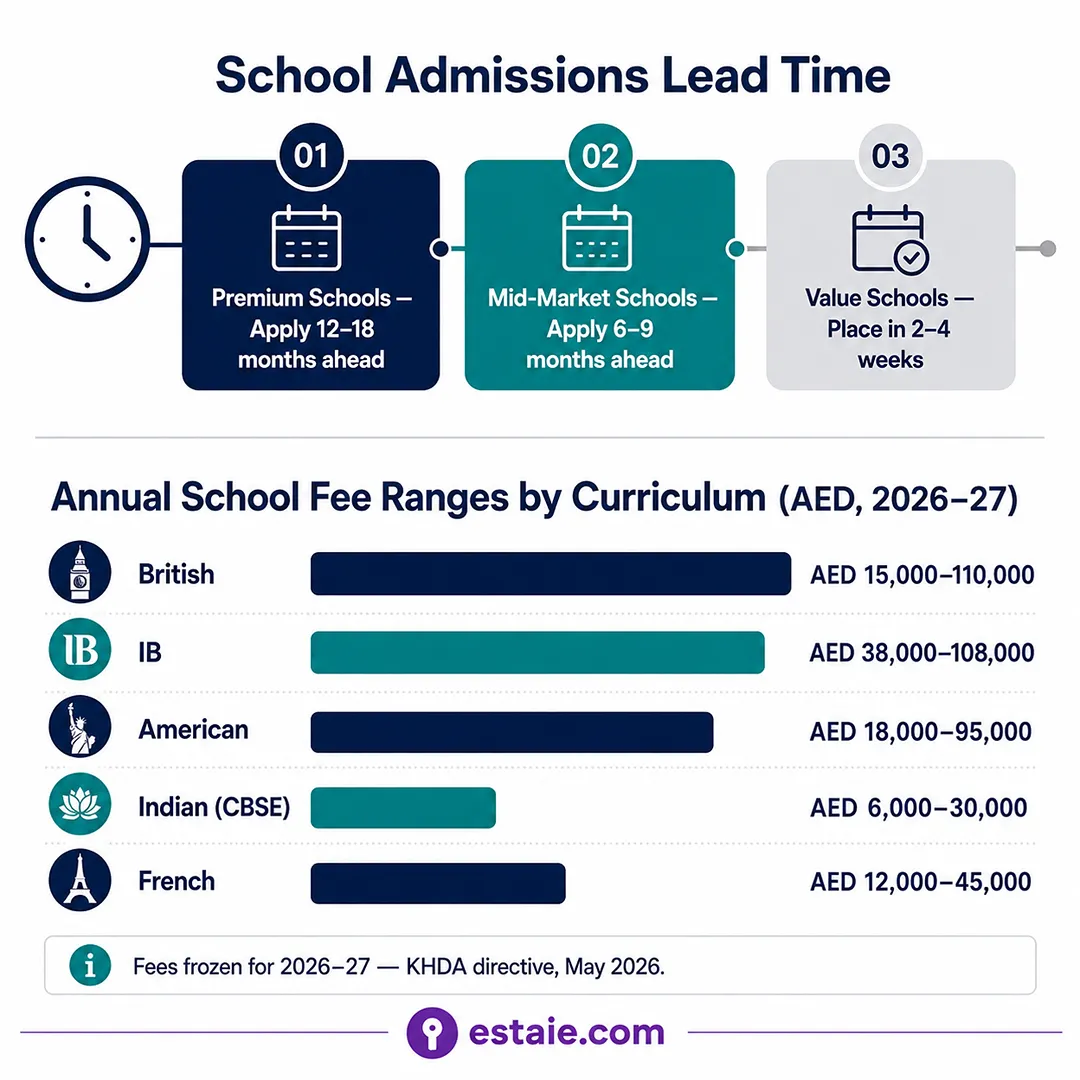
Two 2026 developments matter here and are widely under-reported. First, KHDA confirmed in May 2026 that private school fees will not increase for the 2026-27 academic year, under directives from Sheikh Hamdan bin Mohammed bin Rashid Al Maktoum and as part of a AED 1.5 billion economic incentives package. Budget on this year’s published fees, not on an inflation assumption. Second, full KHDA school inspections have been paused for two consecutive academic years, 2024-25 and 2025-26, so most schools’ publicly displayed rating dates from the 2023-24 inspection round. Treat published ratings as a historical signal and visit in person.
| Curriculum | Annual fee range (AED) | Approx. average (AED) |
| British (UK) | 15,000 – 110,000 | 48,000 |
| IB | 38,000 – 108,000 | 65,000 |
| American | 18,000 – 95,000 | 42,000 |
| Indian (CBSE/ICSE) | 6,000 – 30,000 | 14,000 |
| French | 12,000 – 45,000 | 25,000 |
| German | 25,000 – 55,000 | 38,000 |
Indicative directory data for 2026-27, cross-checked against a second source reporting AED 25,000–60,000 for Foundation Stage, AED 35,000–75,000 primary, AED 45,000–90,000 secondary and AED 55,000–105,000 for sixth form and IB Diploma. Verify with the individual school.
The fee rules themselves are regulated. Application fees are capped at AED 500 and refunded if no place is offered. A first-placement registration deposit can be up to 10% of annual tuition, requested only after you accept a formal offer, and deducted from Term 1 fees. Schools must split tuition into three terms, capped at 40% in Term 1 and 30% in each of Terms 2 and 3, or offer ten monthly instalments.
On timing: premium schools want applications 12 to 18 months out, mid-market schools 6 to 9 months, and value-tier schools can often place a child in 2 to 4 weeks. Assessments generally happen around six months before entry, and offers come with 7 to 14 days to accept. Year 7 and Year 9 entry at the most sought-after British schools are the hardest places to secure. KHDA-rated schools assess every applicant from FS2 upward.
The housing implication is direct. Do not sign an annual lease before you have a school offer in hand, because the wrong side of Sheikh Zayed Road can add 40 minutes to a morning run. Book a furnished family home for the search period, visit the schools, then lease near the one that says yes. Our family extended stay guide covers two- and three-bedroom options by area.
The employee visa process, step by step
The employment relocation sequence runs: work permit, entry permit, medical fitness test, Emirates ID biometrics, residence permit stamping, labour contract registration. End to end, two to four weeks is realistic.
| Step | Authority | Official service time | Indicative fee (AED) |
| Work permit application | MOHRE | 2 working days | 50 application + 250 (Category 1 company, 2 years) |
| Entry permit, applied from outside the UAE | GDRFA Dubai | — | 365 |
| Entry permit, applied from inside (status change) | GDRFA Dubai | — | 1,035 |
| Medical fitness test | DHA-approved centre | 24 working hrs standard; 6 hrs express; 30 min fast-track | 250 standard (market range 250–350) |
| Emirates ID | ICP | 5 days standard | 100 per year of residence + 100 smart services |
| Residence permit issuance | GDRFA Dubai | 48 hours | 740 all-in |
| Document attestation | MOFAIC | 1–3 working days in the UAE | 150 per personal document |
Published government service pages. A Category 1 mainland employment visa comes to roughly AED 1,927 in pure government fees before insurance, PRO fees and attestation. Category 3 companies add around AED 3,200 to the work permit line.
Free zone hires follow a different path: the free zone authority issues the work permit rather than MOHRE, and you pay the zone’s own package price. Industry pricing for a two-year free zone employee visa runs roughly AED 3,400–4,500 applied inside the UAE and AED 4,500–6,500 applied from outside, plus establishment and immigration cards at around AED 1,500 each per year. DIFC and ADGM operate their own employment law regimes rather than the federal one.
The standard employment residence visa is valid for two years and renewable. The overstay fine is standardised at AED 50 per day. A residence visa becomes void after 180 continuous days outside the UAE, and there is a grace period of up to six months after cancellation or expiry.
Sponsoring your family
The minimum salary to sponsor a spouse and children is AED 4,000 a month, or AED 3,000 plus accommodation. The professional-category condition that used to apply has been removed. You can sponsor your spouse, unmarried daughters with no age limit, and sons under 25, raised from 18, with no age limit at all for Golden Visa holders. Medical fitness testing is mandatory for every sponsored family member aged 18 and over, and you have 60 days from a dependant’s arrival on an entry permit to apply for their residence visa.
Sponsoring parents is a different tier: AED 20,000 a month standard, with a humanitarian route at AED 10,000 available through Amer centres. Parent visas are issued for one year and renewed annually regardless of the sponsor’s own visa length, both parents must normally be sponsored together, and a refundable security deposit applies at an amount set case by case by the immigration department.
Executives should note one specific trap. The Golden Visa route for highly skilled professionals requires AED 30,000 a month in basic salary excluding allowances, following a change of interpretation applied from May 2024. Gulf packages are often structured with a low basic and large housing and transport allowances, which can disqualify an otherwise well-paid executive. Check the structure of the offer, not the total.
Where to live in Dubai when you relocate
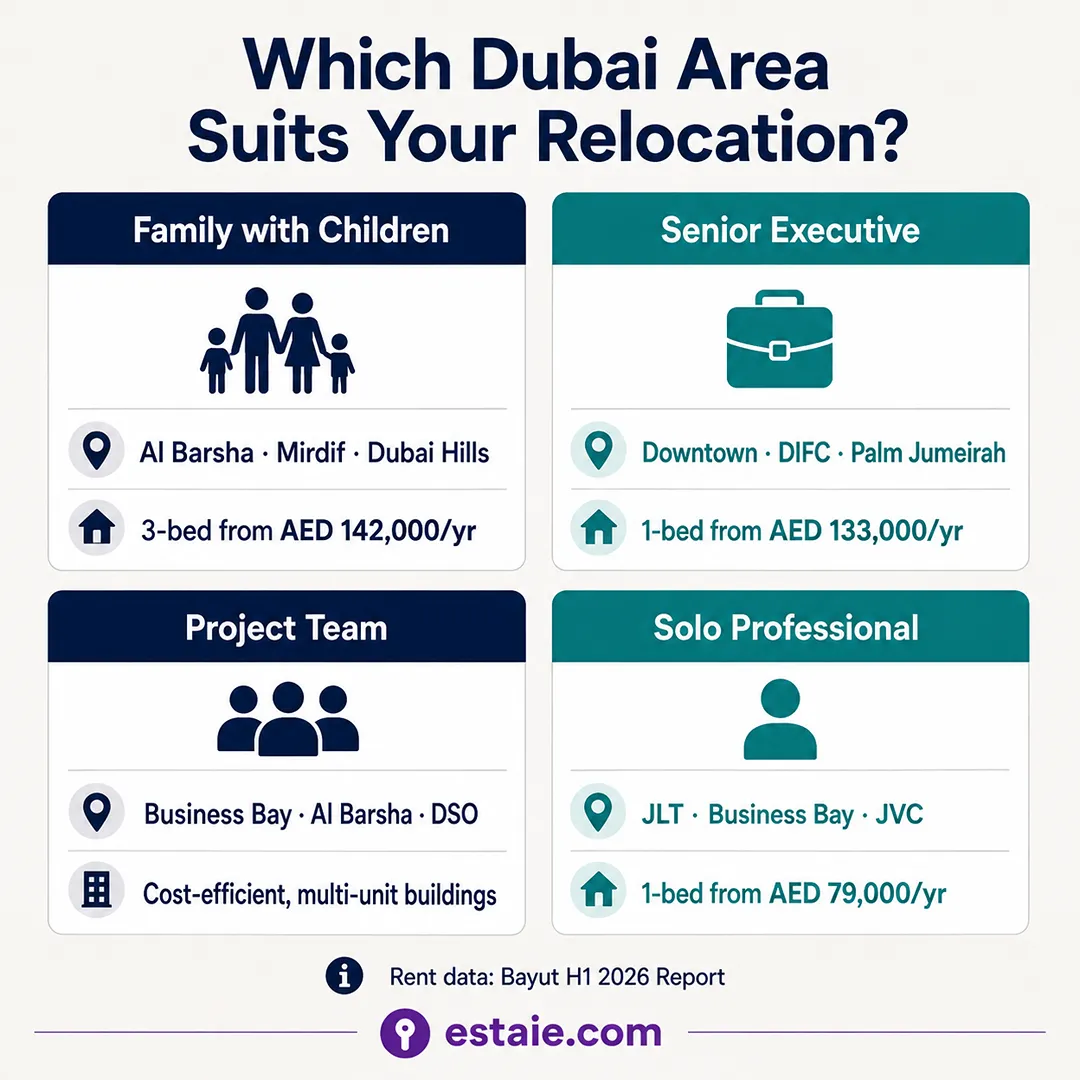
Choose against your actual constraint. There are four common relocation profiles and they point to different parts of the city.
Family with school-age children
Al Barsha, The Greens, Mirdif, Dubai Hills Estate and Arabian Ranches cluster around schools, parks and villa or townhouse stock. Mirdif averaged AED 142,000 a year for a three-bedroom villa in H1 2026, Dubai Hills Estate AED 359,000 for four bedrooms. Book a furnished two- or three-bedroom nearby while you complete admissions rather than committing before the offer letter arrives.
Senior executive or regional head
Downtown, Business Bay, DIFC-adjacent and Palm Jumeirah. Short commutes to the financial district, strong serviced apartment inventory, and the address expectations that come with the role. Downtown one-bedrooms averaged AED 133,000 a year in H1 2026.
Project team or rotational assignment
Business Bay, Al Barsha, Deira and Dubai Silicon Oasis give you cost control, capacity for multiple units in one building, and reasonable access to most work sites. Consolidating a team into one building simplifies transport and invoicing considerably.
Single professional relocating solo
JLT and Business Bay are the practical defaults: metro access, walkable amenities, and one-bedroom stock at AED 79,000–104,000 a year for the equivalent annual lease. JVC offers roughly a quarter off that for a quieter, more car-dependent life.
Whichever profile fits, the sequence is the same. Live somewhere furnished for 60 to 90 days, learn the traffic patterns and the school run, then lease. Our extended stay Dubai guide breaks down all six major districts, and if the assignment is regional we cover extended stays in Abu Dhabi and Riyadh too.
Driving licences, pets, banking and insurance
Health insurance is mandatory in Dubai and the employer must provide cover for the employee, with the sponsor covering dependants. Essential Benefits Plan premiums for lower-salary employees and non-working dependants run around AED 650–725 a year, rising to about AED 1,600 for a married woman aged 18–45 and AED 2,500 for an elderly parent. Comprehensive international-network plans for senior expatriate families cost considerably more, so get a broker quote rather than working from a rule of thumb.
Driving licence conversion is quick if your country qualifies. As of 2026, 57 countries are eligible for direct exchange, including 36 in Europe, the five GCC states, Australia, New Zealand, Canada, the USA, South Africa, Japan, South Korea, China, Turkey and Hong Kong. Kazakhstan was added most recently. The RTA fee is AED 1,050 all in (AED 200 traffic file, AED 600 licence, AED 180 electronic eye test, AED 50 handbook and AED 20 knowledge and innovation fees), and the digital licence is issued instantly. India, Pakistan, the Philippines, Egypt and Nigeria are not on the list, so drivers from those countries must take the knowledge and road tests. You will need your Emirates ID to apply, which puts this after the visa on your timeline.
Bringing a pet requires a MOCCAE import permit valid for 30 days, a microchip, rabies vaccination at least 21 days before travel, a rabies titre result of at least 0.5 IU from blood drawn within the previous 12 months, an accredited health certificate valid for 10 days and endorsed by your national veterinary authority, and internal and external parasite treatment within 14 days of travel. Pets must travel as manifested cargo, not in cabin and not as excess baggage. The annual limit is two cats, or two dogs, or one of each per person. Pit Bulls, Mastiff varieties, Tosa and Presa Canario are banned. Check your monthly accommodation’s pet policy before you book, as it varies by building.
On banking: opening a UAE account generally requires the Emirates ID, and many banks ask for proof of address. A serviced apartment operator can usually issue a stay confirmation letter, which is often the fastest way to satisfy that requirement while you have no Ejari. Ask before you book. It is a small thing that removes a real blocker.
Your 90-day relocation housing checklist
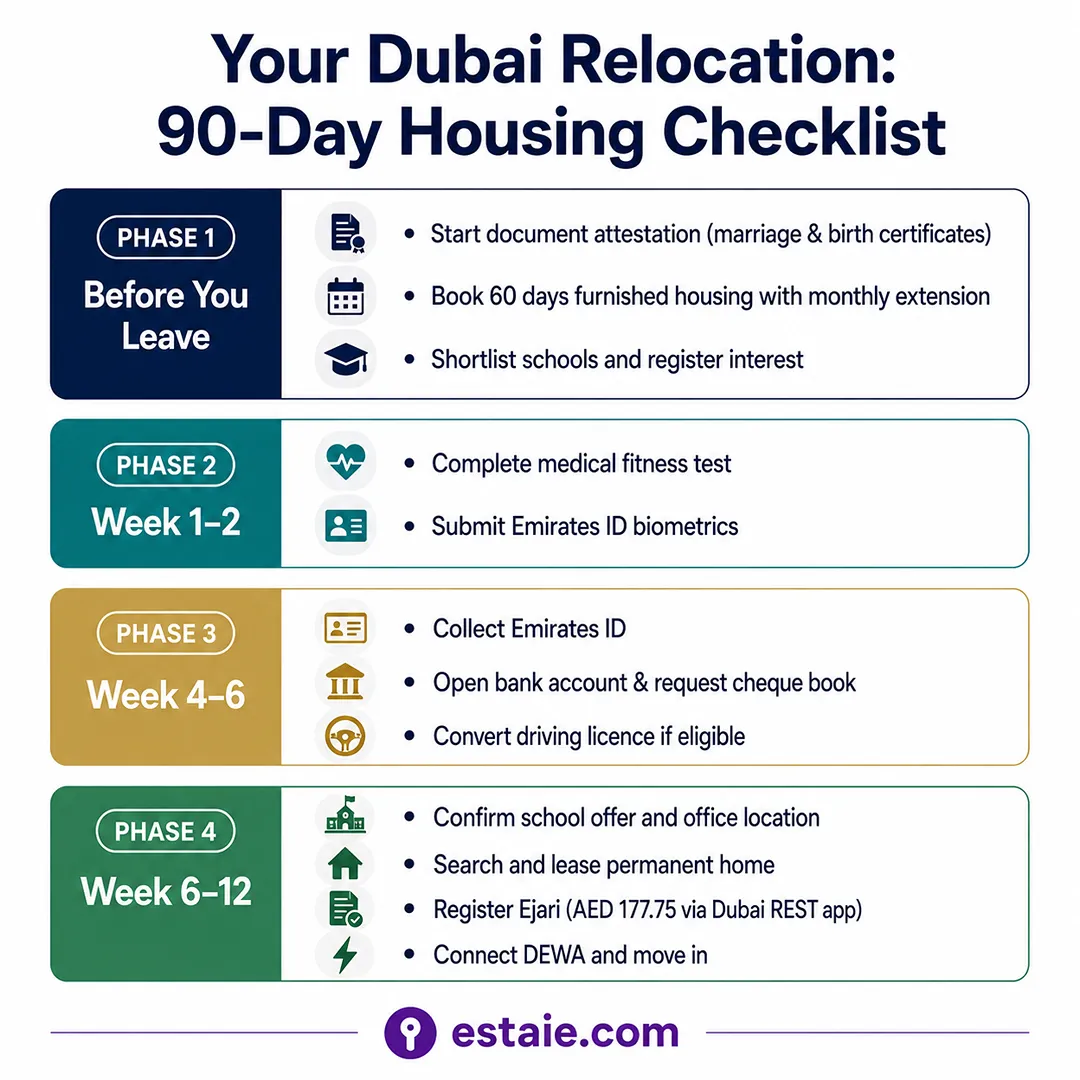
- Before departure: start document attestation for marriage and birth certificates. This is the most common cause of family visa delay and the overseas legs take weeks.
- Before departure: book 60 days of furnished accommodation with a monthly extension option, sized for the whole family, near your likely school or office cluster.
- Before departure: shortlist schools and register interest. Premium schools want 12–18 months’ notice; mid-market 6–9 months.
- Week 1: complete the medical fitness test and submit Emirates ID biometrics.
- Week 2–4: residence permit stamping, labour contract registration, and dependants’ entry permits within the 60-day window.
- Week 4–6: Emirates ID collected, bank account opened, cheque book requested. Convert your driving licence if eligible.
- Week 4–8: property search with the school offer or office location confirmed. Do not lease before both are settled.
- Week 8–12: sign, register Ejari (AED 177.75 via the Dubai REST app), pay the DEWA deposit, connect utilities within 15 working hours, and move.
Why book your Dubai relocation stay with estaie
estaie is built for exactly this window: furnished homes from one month to a year, bookable on a passport, in Dubai and across 22+ countries.
- Book before you land, on a passport. No Emirates ID, no Ejari, no DEWA account and no residence visa required. That is the whole point of the first 90 days.
- At least 32% below nightly rates. Direct partnerships with property operators mean the monthly rate on the same property beats booking night by night by a minimum of 32%.
- One all-in monthly price. Utilities, chiller, internet and housekeeping included, with no agency commission, no security cheques and no furniture to buy. See how estaie works for guests.
- Family and team sizes, not just studios. Two- and three-bedroom homes near school clusters, and consolidated invoicing for teams. See corporate housing in Dubai for volume bookings.
- Extend or move without penalty. School offers land late, visas slip, and the lease you wanted goes to somebody else.
Browse relocation-ready monthly homes in Dubai and book in minutes. Working remotely rather than relocating for a job? See our digital nomad Dubai guide. Moving elsewhere in the region? We cover Riyadh and Abu Dhabi.
Frequently Asked Questions
How long should I book temporary accommodation for when I relocate to Dubai?
Book 60 days minimum with the option to extend monthly, and 90 days if you are moving with children. The residence visa and Emirates ID sequence realistically takes four to eight weeks, and you cannot register a tenancy contract in Dubai without an Emirates ID. Families searching for schools should add time for admissions, which typically involve assessments and a 7 to 14 day window to accept an offer.
Can I rent an apartment in Dubai before my residence visa is issued?
You can book a hotel apartment, licensed serviced apartment or licensed furnished monthly rental with your passport alone. You cannot sign a standard annual lease, because Ejari registration requires you to present a valid Emirates ID in person and DEWA will not connect utilities without an Ejari number. Some landlords will proceed on evidence that your visa is in process, but that is discretionary rather than a rule.
What does relocation accommodation in Dubai cost?
A serviced apartment runs roughly AED 8,800 to AED 13,000 a month, so 90 days costs about AED 26,400 to AED 39,000. The same 90 days in a hotel at Dubai’s 2025 city-wide average daily rate of AED 579 would cost around AED 52,110. A furnished studio starts near AED 4,000 a month, a one-bedroom AED 7,000 to AED 18,000, and a two-bedroom AED 9,000 to AED 22,000, with utilities, internet and cleaning included.
Is a serviced apartment cheaper than an annual lease in Dubai?
For stays under about 14 months, yes. Independent modelling for a one-bedroom in Business Bay or Downtown puts the break-even at around 14 months, with serviced apartments holding a 12 to 18 per cent cost advantage below that once furniture is counted. An annual lease also carries 5% agency commission, a 5–10% security deposit, a AED 2,000 DEWA deposit, chiller deposits, Ejari fees and a 5% Dubai Municipality housing fee, plus a typical early-termination penalty of about two months’ rent.
How long does the UAE employment visa process take?
Two to four weeks end to end is realistic. Individual official service times are short: two working days for the MOHRE work permit, 24 working hours for a standard medical fitness test, five days for the Emirates ID and 48 hours for residence permit stamping. Queuing, typing centre steps and document attestation add the rest. Attestation of foreign marriage and birth certificates is the most common source of delay, so start it before departure.
How much temporary housing does a corporate relocation package usually include?
Thirty to 90 days is the standard band in international relocation packages, alongside moving services, house-hunting trips, destination services, school search, spousal career support and tax equalisation. In survey data on international assignments, corporate housing and suite hotels were each used by 67% of organisations, with full-service hotels at 39%, and 61% managed temporary housing through a third-party provider.
What salary do I need to sponsor my family in Dubai?
AED 4,000 a month, or AED 3,000 a month plus accommodation, to sponsor a spouse and children. The old professional-category condition no longer applies. You can sponsor unmarried daughters with no age limit and sons under 25. Sponsoring parents requires AED 20,000 a month, with a humanitarian route at AED 10,000 through Amer centres, and parent visas are issued for one year at a time.
When does the Dubai school year start and how early should I apply?
Term 1 of the 2026-27 academic year begins on Monday 31 August 2026. Premium schools want applications 12 to 18 months ahead, mid-market schools 6 to 9 months, and value-tier schools can often place a child within 2 to 4 weeks. Assessments usually happen around six months before entry and offers carry a 7 to 14 day acceptance window. Year 7 and Year 9 entry at the most in-demand British schools are the hardest to secure.
How much are school fees in Dubai in 2026?
KHDA confirmed in May 2026 that private school fees will not increase for the 2026-27 academic year. Indicative annual ranges are AED 15,000–110,000 for British curriculum (averaging around AED 48,000), AED 38,000–108,000 for IB, AED 18,000–95,000 for American and AED 6,000–30,000 for Indian curriculum schools. Application fees are capped at AED 500 and the first-placement registration deposit can be up to 10% of annual tuition.
Where should a family live when relocating to Dubai?
Choose the area after you have a school offer, not before. Al Barsha, The Greens, Mirdif, Dubai Hills Estate and Arabian Ranches are the established family clusters, with parks, villa and townhouse stock and school proximity. Book a furnished two- or three-bedroom home nearby for the 60 to 90 days it takes to complete admissions and paperwork, then lease near the school that offers your child a place.
Can I convert my driving licence in Dubai?
If your country is one of the 57 eligible for direct exchange, yes. The RTA fee is AED 1,050 all in and the digital licence is issued instantly. The list covers 36 European countries, the five GCC states, Australia, New Zealand, Canada, the USA, South Africa, Japan, South Korea, China, Turkey and Hong Kong, with Kazakhstan added most recently. You need a valid Emirates ID to apply. India, Pakistan, the Philippines, Egypt and Nigeria are not on the list, so licence holders from those countries must take the knowledge and road tests.
What is Ejari and why does it matter for relocation?
Ejari is the Dubai Land Department system that registers a tenancy contract and gives it legal standing. It costs AED 177.75 through the Dubai REST app or AED 220 at a Real Estate Trustee Centre, and takes about 25 minutes. It matters because you need a valid Emirates ID to register it, DEWA will not connect your utilities without an Ejari number, and you also need it for fibre internet in your own name, an RTA resident parking permit and any case at the Rental Dispute Centre. That dependency chain is the reason relocating employees spend their first weeks in furnished monthly accommodation.