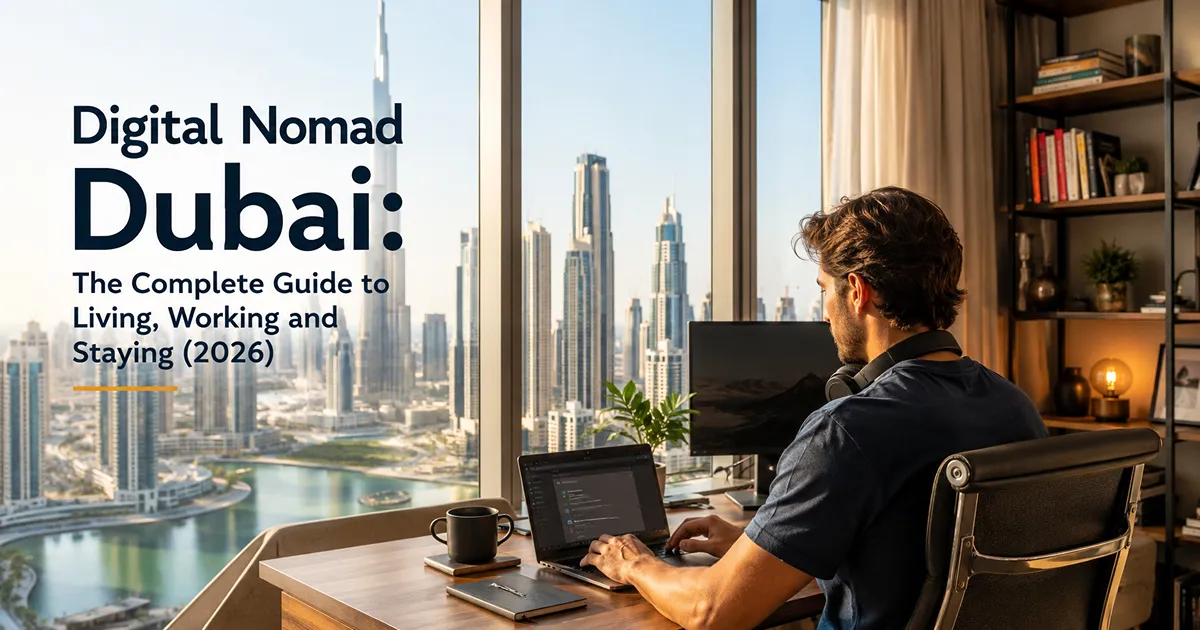
Dubai works for digital nomads because three things line up at once: a one-year residence visa you sponsor yourself, zero personal income tax, and the fastest mobile internet in the world. The UAE ranked first globally for median mobile download speed at 642.86 Mbps in Ookla’s May 2026 Speedtest Global Index, and Savills has placed Dubai at number one in its Executive Nomad Index for two consecutive years. What Dubai does not hand you is somewhere to live. That part is on you, and it is the part almost every guide skips.
This guide fixes that. You will find the two different income thresholds for the UAE remote work visa (they are not the same number, and most articles quote only one), what a furnished monthly apartment actually costs by area, what a coworking desk runs per month, how the tax rules work for employees versus freelancers, and the thing nobody writes about: what you can legally book before your Emirates ID arrives. Every figure here carries a date and a source.
On this page
- Is Dubai actually good for digital nomads?
- The UAE digital nomad visa: two routes, two income thresholds
- Other ways to stay: tourist visa, freelance permit, Green Visa
- Where you actually live: the accommodation gap nobody explains
- What a monthly apartment in Dubai costs in 2026
- Best areas in Dubai for remote workers
- Coworking in Dubai: what a desk really costs
- Internet, SIM cards and calling apps
- Working from Dubai across time zones
- Dubai vs Lisbon, Bangkok, Bali and Barcelona
- Do digital nomads pay tax in Dubai?
- Surviving July and August
- How to book a monthly stay in Dubai
- Why book with estaie
- Frequently asked questions
Is Dubai actually good for digital nomads?
Yes, if your work is remote and your income is above roughly USD 3,500 a month. Dubai gives you legal residency without an employer, no personal income tax, world-leading connectivity, and a working week that runs Monday to Friday. The UAE moved its federal government to a Monday–Friday week with a Saturday–Sunday weekend in January 2022, which put the country on the same calendar as its clients in Europe and North America. The trade-off is cost. Numbeo put a single person’s monthly expenses in Dubai at AED 4,130.80 excluding rent as of 24 July 2026, which is roughly five times what the same profile costs in Denpasar.
It is worth being honest about the split verdict. Savills ranked Dubai first in the world in its 2025 Executive Nomad Index, scoring internet speed, air connectivity, climate and quality of life. Nomads.com, which is scored by user submissions rather than data, ranks Dubai 227th and its members complain about walkability and summer heat. Both are measuring real things. Dubai is excellent if you want infrastructure, safety, flight connections and a legal base; it is weaker if your ideal is a walkable, cheap, café-hopping city. Knowing which of those you are is the whole decision.
One more thing that shapes everything below: Dubai’s population reached 4.58 million at the end of 2025, growing 7.5% in a single year. That is the fastest in the emirate’s history, according to figures reported by Gulf News in July 2026. That growth is what keeps rents firm and monthly inventory moving quickly. Book earlier than you think you need to.
The UAE digital nomad visa: two routes, two income thresholds
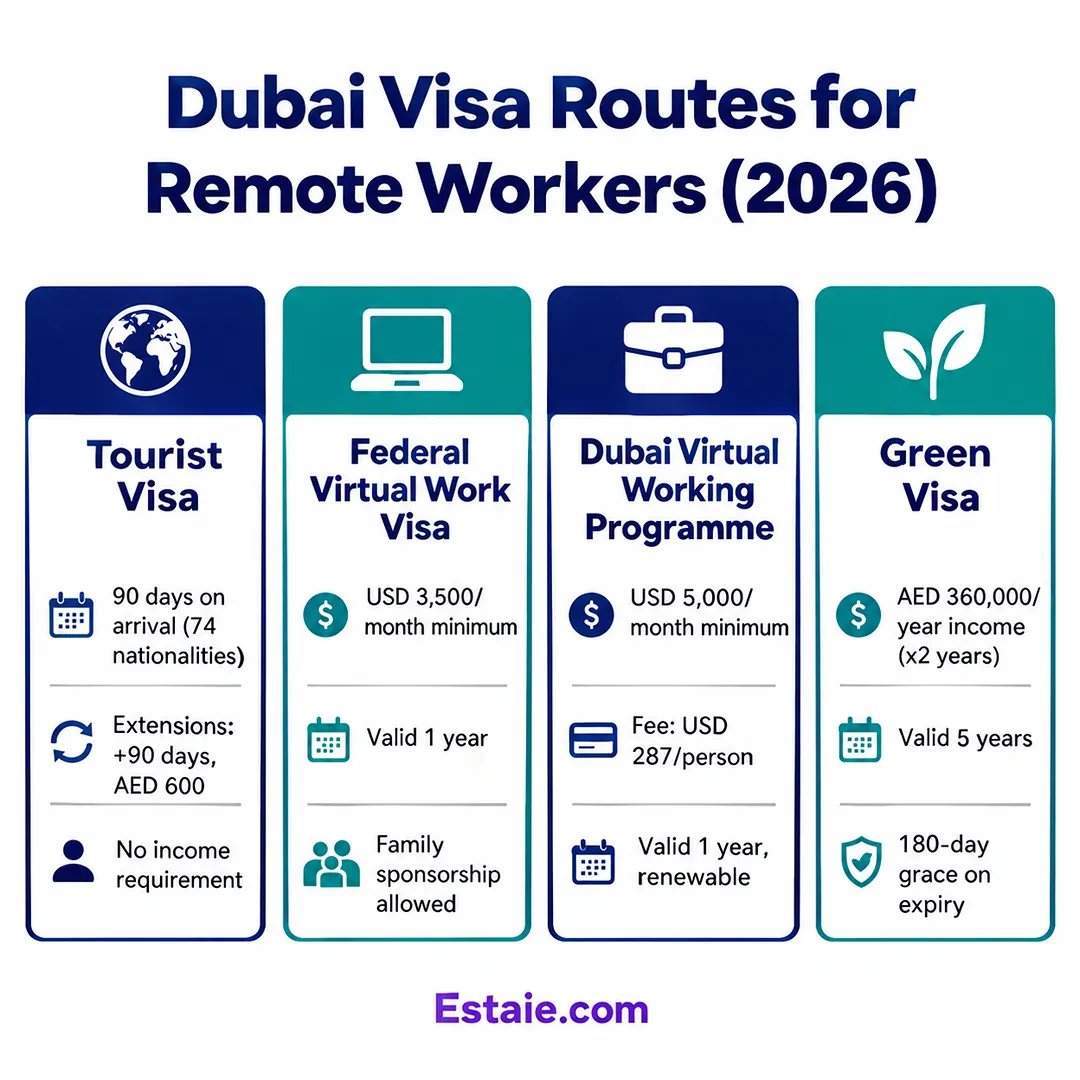
There are two separate remote work visas, and they have different income requirements. The federal virtual work residence visa, issued through the ICP, requires a salary certificate showing a minimum of USD 3,500 per month. Dubai’s own Virtual Working Programme, described on the UAE government portal u.ae, requires USD 5,000 per month. Both are valid for one year. Almost every guide online publishes one of these numbers as if it were the only one. Check which route you are applying through before you gather documents.

| Route | Federal virtual work visa (ICP) | Dubai Virtual Working Programme |
| Minimum monthly income | USD 3,500 | USD 5,000 |
| Validity | 1 year | 1 year, renewable on re-application |
| Stated fee | Government fees vary by channel | USD 287 per person |
| Issuing body | ICP (federal), or GDRFA Dubai | GDRFA Dubai |
| Health insurance | Required | Required |
| Family sponsorship | Permitted | Permitted |
Source: u.ae residence visa pages, federal page last updated 3 March 2026.
What you need to submit is broadly the same either way: a passport valid for at least six months, valid UAE health insurance, and proof of the income. Employees show an employment contract with at least a year left to run, a recent salary slip and three months of personal bank statements. Company owners show proof of ownership for at least a year plus three months of company bank statements. The federal route also asks for medical fitness test results.
Processing is fast by international standards. GDRFA Dubai typically turns applications around in two to five working days, and ICP applications in about two. Government fees sit somewhere between AED 350 and AED 750 depending on whether you apply from outside the UAE or convert your status from inside it; the in-country status change adds a standard AED 500 line. Once approved, you have 60 days to enter the country.
The visa gets you an Emirates ID, which is mandatory for every UAE resident. The ICP charges AED 100 per year of residence plus a AED 100 smart services fee, so a one-year remote work visa produces an Emirates ID bill of roughly AED 200 before typing centre charges. Standard issuance takes five days and requires in-person biometrics. Hold on to that timeline, because it becomes the single most important number in the accommodation section below.
Other ways to stay: tourist visa, freelance permit, Green Visa
Not everyone needs a remote work visa. If you are testing Dubai for a few months, or your income sits below the threshold, there are three realistic alternatives.
The tourist route is the simplest. The UAE offers a five-year multiple-entry tourist visa allowing 90 days per visit, extendable by a further 90, available to all nationalities. Around 74 nationalities, including the UK, US, Canada, Australia, all EU and EEA states, Japan, South Korea, Singapore and China, get 90 days visa-free on arrival. Extensions through GDRFA Dubai cost AED 600 plus VAT and can be repeated, though total extension time is capped at 120 days. Be aware that the UAE has clarified visa-on-arrival for several major nationalities as 90 days within a rolling 180-day period rather than 90 days per entry, so back-to-back border runs are not the loophole they once were. Overstaying costs AED 50 per day.
A freelance permit makes sense if you want to invoice UAE clients. TECOM’s GoFreelance package is AED 7,500 a year and covers a freelance licence plus hot-desk access at one of four Dubai free zones. Adding a two-year employment visa costs AED 5,042, and the required establishment card is AED 2,000, so a realistic first-year total is around AED 14,542 before insurance and medical fitness. It covers tech, media, education and design.
The Green Visa is the five-year, self-sponsored option for established freelancers. The ICP requires a MoHRE freelance permit, a bachelor’s degree or specialised diploma, and annual income of at least AED 360,000 in each of the previous two years. GDRFA Dubai processes it in 48 hours and it carries a 180-day grace period on expiry, which is unusually generous. Above that sits the ten-year Golden Visa, which now has a creative talent category covering filmmakers, photographers, writers and content creators, announced for Dubai in March 2025. GDRFA Dubai issued 66,078 Golden Visas in the first half of 2026 alone.
Where you actually live: the accommodation gap nobody explains
Here is the problem no visa guide will tell you about. You cannot sign a normal annual apartment lease in Dubai until you have an Emirates ID. Ejari, the Dubai Land Department system that makes a tenancy contract legally valid, requires the tenant to present a valid Emirates ID in person. DEWA will not connect electricity or water without a valid Ejari number. And the Emirates ID itself sits at the end of the visa chain: entry, medical fitness test, biometrics, residence permit, then the card.
Realistically that is four to eight weeks from landing to the point where you can legally hold a lease, and that assumes nothing in your document attestation goes sideways. During that window your only legal options are hotel apartments, licensed serviced apartments and licensed holiday homes, all of which you can book on a passport alone. This is not a workaround. It is how the system is designed to work, and it is exactly the gap extended-stay accommodation exists to fill.
| Stage | What you have | What you can book |
| Before you arrive | Passport only | Hotel apartment, serviced apartment or licensed furnished monthly rental — no visa needed |
| Week 1–2 in Dubai | Entry permit, medical test done | Same. Extend your monthly stay rather than committing to a lease |
| Week 2–4 | Biometrics submitted, residence permit in process | Same. Some landlords will accept evidence the visa is in progress, but this is discretionary |
| Week 4–8 | Emirates ID issued | Annual lease with Ejari registration becomes possible |
| After Emirates ID | Bank account, cheque book | Full access to the annual rental market, including cheque-based payment plans |
Sources: Dubai Land Department Ejari service page (updated 9 July 2026); DEWA move-in service (updated 16 May 2026); ICP Emirates ID issuance.
There is a second reason to think carefully before rushing into an annual lease, and it is financial rather than procedural. A Dubai annual tenancy is front-loaded with costs that never appear in the advertised rent: agency commission at 5% of annual rent, a security deposit of 5% unfurnished or 10% furnished, Ejari registration at AED 177.75 through the Dubai REST app, a DEWA security deposit of AED 2,000 for an apartment plus AED 125 activation, and a Dubai Municipality housing fee of 5% of annual rent collected in twelve instalments on your DEWA bill. Then you furnish it. On a mid-market two-bedroom in Business Bay at Bayut’s H1 2026 average of AED 148,000 a year, paid in four cheques, day-one cash is roughly AED 55,600 before a single piece of furniture.
If you are staying under a year, which describes most digital nomads, the maths favours a furnished monthly stay by a wide margin, because the monthly rate already includes utilities, internet, cleaning and furniture, and there is no early-termination penalty to negotiate. For the full breakdown of how monthly stays work, see our guide to what an extended stay is and our main extended stay Dubai pillar.
What a monthly apartment in Dubai costs in 2026
A furnished studio on a monthly booking in Dubai starts at around AED 4,000 and runs to about AED 11,000. A one-bedroom is roughly AED 7,000 to AED 18,000, and a two-bedroom AED 9,000 to AED 22,000. Premium districts like Downtown, Palm Jumeirah and Jumeirah sit at the top of those bands or above them. Those prices are all-in: electricity, water, internet and housekeeping are normally bundled into the single monthly figure.
| Home type | Monthly range (AED) | Approx. monthly (USD) | Typically suits |
| Furnished studio | 4,000 – 11,000 | 1,090 – 2,995 | Solo nomad, 1–3 months |
| One-bedroom | 7,000 – 18,000 | 1,905 – 4,900 | Solo or couple, workspace needed |
| Two-bedroom | 9,000 – 22,000 | 2,450 – 5,990 | Couple with an office, or two people sharing |
| Budget long-stay hotel room | 3,499 – 5,999 | 953 – 1,634 | Lowest cost, smallest space |
USD converted at the UAE Central Bank peg of AED 3.6725 = USD 1. Budget long-stay band based on published 30-night hotel monthly rates in Dubai, valid to 31 August 2026.
Two things move that price more than anything else. The first is length of stay. Most operators drop the monthly rate as the booking gets longer, so three or six months often costs less per month than a single month. Ask. The second is the all-in versus nightly gap. Booking the same apartment night by night adds cleaning fees, service charges and peak-season pricing that can quietly add 10–15% or more; estaie’s own partner rates run at least 32% below the nightly equivalent for the same property.
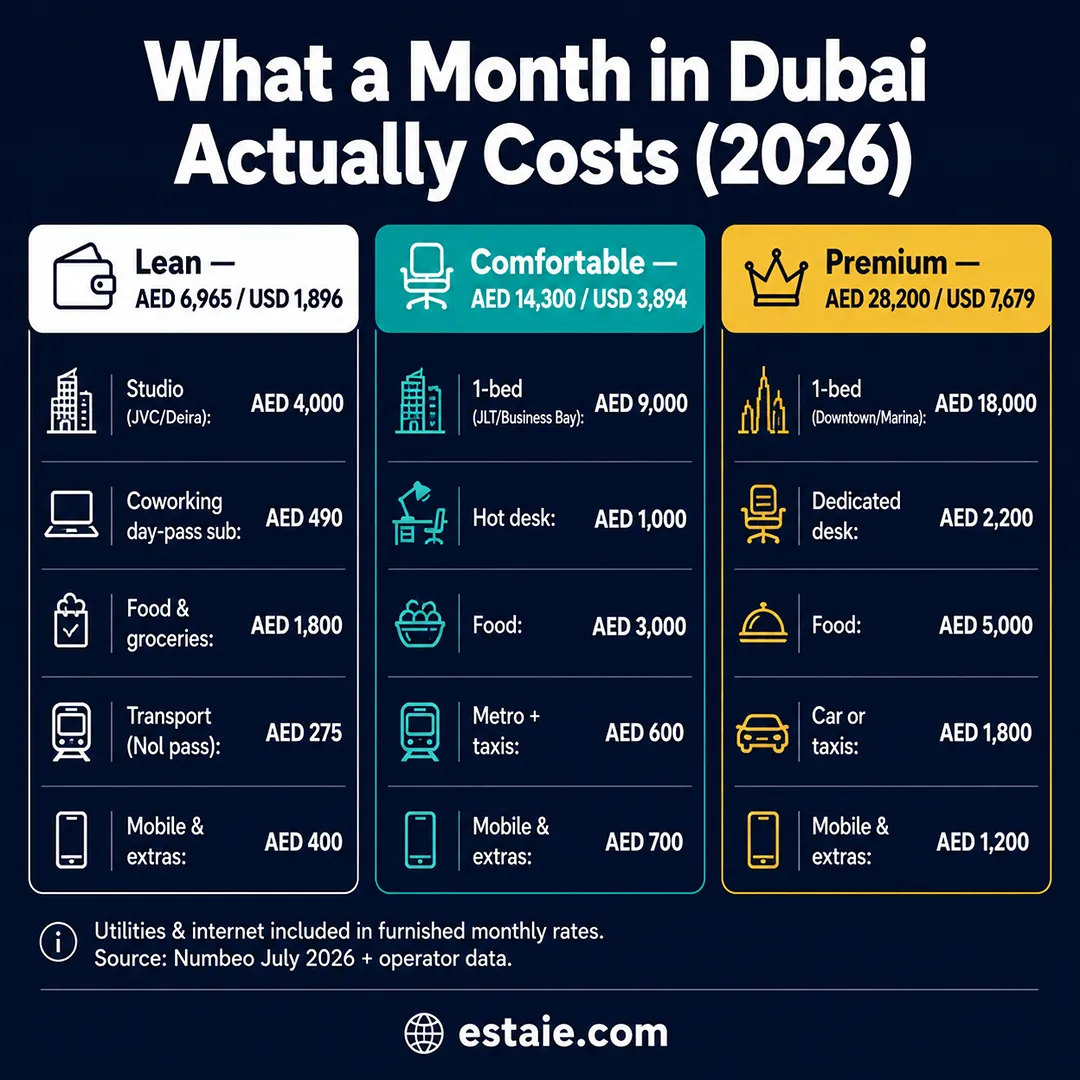
Set against the rest of your budget, here is what a realistic month in Dubai looks like. Numbeo’s July 2026 data puts single-person costs excluding rent at AED 4,130.80, with a monthly public transport pass at AED 275, a mobile plan with 10 GB+ at AED 200.64, home internet at AED 346.50 and a gym at AED 310.56, though budget chains like GymNation advertise from AED 99.
| Monthly budget | Lean | Comfortable | Premium |
| Furnished home | 4,000 (studio, JVC/Deira) | 9,000 (1-bed, JLT/Business Bay) | 18,000 (1-bed, Downtown/Marina) |
| Coworking | 490 (day-pass subscription) | 1,000 (hot desk) | 2,200 (dedicated desk) |
| Food & groceries | 1,800 | 3,000 | 5,000 |
| Transport | 275 (Nol pass) | 600 (metro + taxis) | 1,800 (car or daily taxis) |
| Mobile & extras | 400 | 700 | 1,200 |
| Estimated total (AED) | 6,965 | 14,300 | 28,200 |
| Estimated total (USD) | 1,896 | 3,894 | 7,679 |
Utilities and internet are excluded from the home line because they are normally included in a monthly furnished rate. Compiled from Numbeo (24 July 2026), RTA published Nol fares and operator-published coworking rates.
Best areas in Dubai for remote workers
Where you base yourself matters more in Dubai than in most cities, because the city is large, the summer is severe, and a badly chosen address turns every errand into a 30-minute drive. Prioritise metro access and walkable amenities over view.
1. Jumeirah Lake Towers (JLT): Best all-round choice
JLT sits directly on the metro, is built around walkable lakeside promenades, and has the highest density of cafés and small coworking spaces per square kilometre in the city. Rents are meaningfully below Marina and Downtown for comparable space. If you want one recommendation without qualifiers, this is it.
2. Business Bay & Downtown: Best for client-facing work
If your week involves meetings in DIFC or Downtown, this is the place to be. Business Bay averaged AED 104,000 a year for a one-bedroom in Bayut’s H1 2026 report, Downtown AED 133,000. You pay a premium for the address and the proximity. Browse Downtown Dubai apartments to compare.
3. Dubai Marina & JBR: Best for waterfront social living
Waterfront, high-rise, restaurant-dense, and very walkable within its own bubble. Marina averaged AED 103,000 a year for a one-bedroom in H1 2026. Traffic at peak hours is the trade-off, and tower noise varies enormously by floor and orientation, so always ask which floor and which side before you book. See serviced apartments in Dubai Marina and long stay options in JBR.
4. Al Barsha & The Greens: Best for space and central access
Next to Mall of the Emirates, well connected, quieter, greener, and priced sensibly. Good if you want space and a short commute in every direction without paying Downtown rates. Explore Al Barsha extended stays.
5. JVC & Dubai Silicon Oasis: Best value for longer stays
Jumeirah Village Circle averaged AED 79,000 a year for a one-bedroom in H1 2026, roughly 25% below Business Bay. Both areas are quieter and more residential; both usually need a car. Best once you know the city and want to stretch a budget over six months rather than one.
6. Deira & Bur Dubai: Best for tight budgets and airport runs
Older buildings, the most affordable rents in the city, excellent street food and a ten-minute run to the airport. If you fly out constantly and do not need polish, the value is real. See hotel apartments near Dubai Airport.
For a fuller neighbourhood-by-neighbourhood comparison, our extended stay Dubai guide covers all six areas in more depth.
Coworking in Dubai: what a desk really costs
Expect AED 800–1,500 a month for a hot desk, AED 1,200–2,200 for a dedicated desk, and AED 75–150 for a day pass. DIFC and Downtown locations command roughly 30–40% more than emerging districts, so the same product costs noticeably more depending on postcode.
| Option | Day pass (AED) | Monthly (AED) | Notes |
| Café/venue credit subscription | 39 and up | 490 and up | Credits spendable across partner cafés, hotels and workspaces; unused credits roll over |
| Independent coworking (e.g. JLT) | 80 + VAT | 1,000 | Weekly options around 400 |
| Tech-hub community membership | — | 1,500 (24/7 access) | Evening-and-weekend tiers around 750; light 5-day tiers around 650 |
| Global operator hot desk | from 139 | from ~1,233 | Dedicated desks priced on request |
| Market range, hot desk | 75 – 150 | 800 – 1,500 | Dedicated desk 1,200 – 2,200; private office 2,500 – 3,500 |
Operator-published rates and a Dubai coworking cost survey dated 16 April 2026. Verify current pricing with the operator before committing.
Two practical notes. First, if you work fewer than ten days a month outside the apartment, a credit-based day-pass subscription almost always beats a fixed desk. Second, many serviced apartment buildings include a business centre or shared lounge; check what your building already gives you before you buy a membership you will use twice.
If you would rather work from a hotel with a proper desk and reliable Wi-Fi, our roundup of the best hotels for remote work in Dubai covers the properties that actually get the workspace right.
Internet, SIM cards and calling apps
Connectivity is the strongest single argument for Dubai. The UAE ranked first in the world for median mobile download speed at 642.86 Mbps in Ookla’s May 2026 data, and third globally for fixed broadband. In practice, video calls work everywhere, tethering is genuinely viable as a backup, and 5G home wireless is a real alternative to fibre.
Home internet packages from the two operators, e& and du, run from around AED 229–349 a month for 5G home wireless up to AED 389–429 for 250 Mbps to 1 Gbps fibre. Numbeo’s July 2026 figure for a 60 Mbps+ unlimited connection is AED 346.50. Mobile plans with 10 GB or more average AED 200.64 a month, with prepaid daily data packs available from around AED 1.50 a day if you are only in town briefly. Operator pricing changes often, so check the current tiers directly before you commit.
In a furnished monthly apartment, internet is almost always included in the rate. That is worth more than it sounds, because getting fibre installed in your own name requires an Ejari number, which brings you back to the Emirates ID chain. One question is worth asking every operator before you book: what speed does the apartment actually get, and is the router in the room you will work in? Nobody publishes this at property level, so ask.
On calling apps: check the current position on VoIP services before you rely on WhatsApp or FaceTime calls for client work. Licensed alternatives including Microsoft Teams, Zoom and Google Meet operate normally, and most remote workers simply default to those.
Working from Dubai across time zones
Dubai runs on Gulf Standard Time, UTC+4, with no daylight saving all year. That single fact makes it one of the best-positioned cities on earth for anyone working with Europe and Asia in the same day, and one of the worst for anyone working with the US West Coast.
| Your team is in | Offset vs Dubai | Usable overlap with a 09:00–18:00 Dubai day |
| India | +1.5 h | About 7.5 hours |
| Central Europe (summer) | −2 h | About 7 hours |
| London (summer) | −3 h | About 6 hours |
| Singapore / Hong Kong | +4 h | About 5 hours, in your morning |
| Tokyo | +5 h | About 4 hours, early morning |
| Sydney | +6 h | About 2 hours, first thing |
| New York (summer) | −8 h | About 1 hour, late afternoon |
| US West Coast | −11 h | None — you work evenings |
Calculated from published UTC offsets, assuming a 09:00–18:00 working day in each location. The UAE does not observe daylight saving.
The honest read: if your clients are European, Dubai is close to ideal and the Monday–Friday working week removes the friction that used to come with a Gulf posting. If your clients are Californian, you will be taking calls at 20:00 and later, permanently. Decide that before you sign a six-month booking.
Dubai vs Lisbon, Bangkok, Bali and Barcelona
Dubai is not the cheapest nomad base and does not pretend to be. What it offers is a legal, tax-free, high-infrastructure base with direct flights almost everywhere. Here is how the 2026 numbers compare.
| City | Visa | Income requirement | Length | Living cost excl. rent | Personal income tax |
| Dubai | Virtual work residence visa / Dubai VWP | USD 3,500/mo federal; USD 5,000/mo Dubai programme | 1 year, renewable | AED 4,131 (~USD 1,125) | 0% |
| Lisbon | D8 remote work visa | 4× Portuguese minimum wage (€920 from 1 Jan 2026 → €3,680/mo) | Residence visa to permit | €760 (~USD 876) | Portuguese tax residency after 183 days |
| Bangkok | Destination Thailand Visa | THB 500,000 held 3+ months | 5 years, 180 days per entry | THB 22,337 (~USD 686) | Not conferred by the visa |
| Bali | E33G Remote Worker KITAS | USD 60,000/year foreign income | 1 year, not extendable | IDR 7.2m (~USD 404) | Taxed on worldwide income |
| Barcelona | International Teleworking visa | 200% of Spanish SMI (€1,221/mo from Feb 2026 → €2,849/mo) | 1 year visa, then 3-year permit | €815 (~USD 930) | Optional flat-rate regime may apply |
Cost of living: Numbeo city data, retrieved between May and July 2026. Income thresholds from official government and consular sources. Spain’s threshold rose in February 2026 and Portugal’s on 1 January 2026, so most published comparisons still show the older figures.
The pattern is clear enough. Southeast Asia wins on cost. Southern Europe wins on lifestyle-per-euro. Dubai wins on tax, infrastructure, flight connectivity and the speed of getting legal. A 48-hour to five-day visa decision is not something Lisbon or Barcelona can match. Where Dubai loses is walkability and summer.
Do digital nomads pay tax in Dubai?
The UAE does not levy personal income tax on individuals. If you are a remote employee on a foreign payroll, your UAE tax position on that salary is zero. That is the headline and it is accurate.
The detail matters for freelancers. UAE corporate tax applies at 0% on taxable income up to AED 375,000 and 9% above it, for businesses operating under a commercial licence. Crucially, Cabinet Decision No. 49 of 2023 sets a threshold for natural persons: your business activity only enters the corporate tax net if turnover from it exceeds AED 1,000,000 in a calendar year. Wage, personal investment income and real estate investment income are explicitly excluded regardless of amount. So a remote employee is outside the regime entirely; a freelancer with a UAE licence pays nothing until UAE business turnover passes AED 1 million, then 0% up to AED 375,000 of taxable income and 9% above.
VAT is 5% on goods and services. And a caution that applies everywhere: the UAE’s rules describe your UAE position only. Your home country may still tax you based on residency, citizenship or days present. Get advice specific to your own passport before you assume anything.
Surviving July and August
Dubai’s summer is the one thing every nomad underestimates. From June to September, outdoor life effectively stops between mid-morning and evening, and the single most common complaint from nomads about the city is that it becomes unwalkable.
The fix is architectural rather than seasonal. Choose a building that connects to something: a metro station, a mall, an air-conditioned podium. JLT, Downtown, Business Bay, Deira and Al Barsha all have towers within a short covered or very short outdoor walk of a metro entrance, which means you can live a normal week in August without ever standing in 45°C. In the same months, monthly rates soften and availability improves, so if you can tolerate the heat, summer is when the value is.
Also budget for cooling. In buildings on district cooling, chiller charges for a one-bedroom can reach AED 900–1,400 a month in July and August. In a furnished monthly stay these are normally inside your rate. Confirm that they are, because it is the single biggest hidden line in a Dubai summer.
How to book a monthly stay in Dubai
Booking a monthly home in Dubai is straightforward when you use a platform built for stays of 30 nights and up rather than one built for holidays.
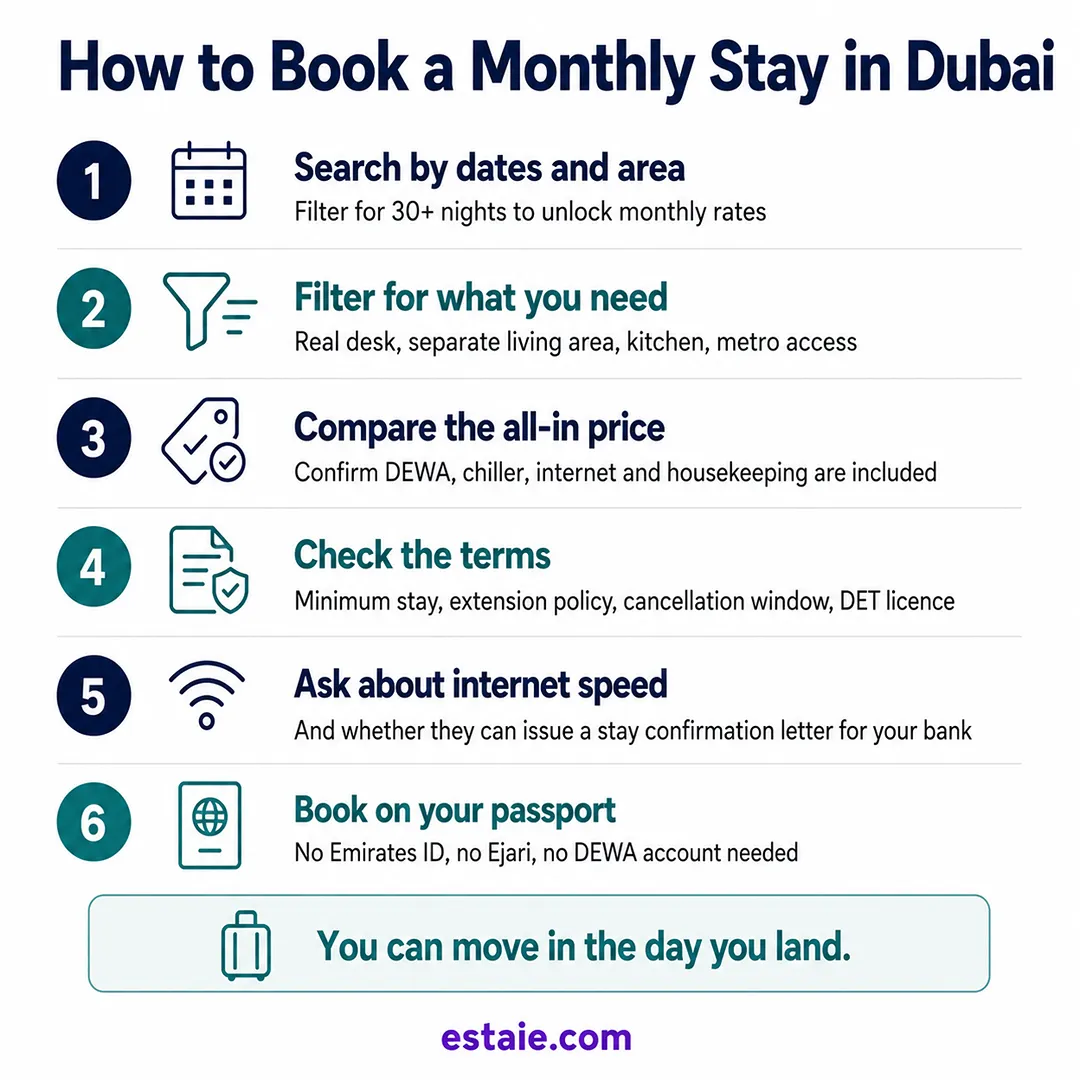
- Search by dates and area, filtering for 30 nights or more so you see discounted monthly rates instead of nightly ones.
- Filter for what you actually need: a real desk, a separate living area if you take calls, a kitchen, and proximity to a metro station.
- Compare the all-in monthly price. Confirm it includes DEWA, chiller, internet and housekeeping, because those four lines are where surprises hide.
- Check the terms. Minimum stay, extension policy, cancellation window, and whether the operator is licensed by Dubai’s Department of Economy and Tourism.
- Ask about the internet speed in the unit and whether the operator can issue a stay confirmation letter, which is useful for bank account applications while your Ejari does not yet exist.
- Book and move in. Fully furnished and all-inclusive means you start working the day you land.
You will need only your passport. Hotel apartments and licensed serviced apartments are booked the same way a hotel room is, with no UAE residency required, which is precisely why they work for the first months of a stay. Only a private residential lease demands a residence visa, an Emirates ID and an Ejari-registered contract.
Why book your Dubai stay with estaie
estaie exists for exactly this kind of stay: flexible, furnished homes from one month to a year, in Dubai and across 22+ countries.
- One platform, three formats. Compare hotel apartments, serviced apartments and private furnished homes side by side instead of across four different sites.
- At least 32% below nightly. Working directly with property partners means the monthly rate on the same property beats booking it night by night by a minimum of 32%.
- One clear monthly price. Utilities, internet and cleaning included, no agency commission, no security cheques, no Ejari, no DEWA account to open. See how estaie works for guests.
- Built for stays, not holidays. Extend, shorten or move between properties as your plans change, because they will.
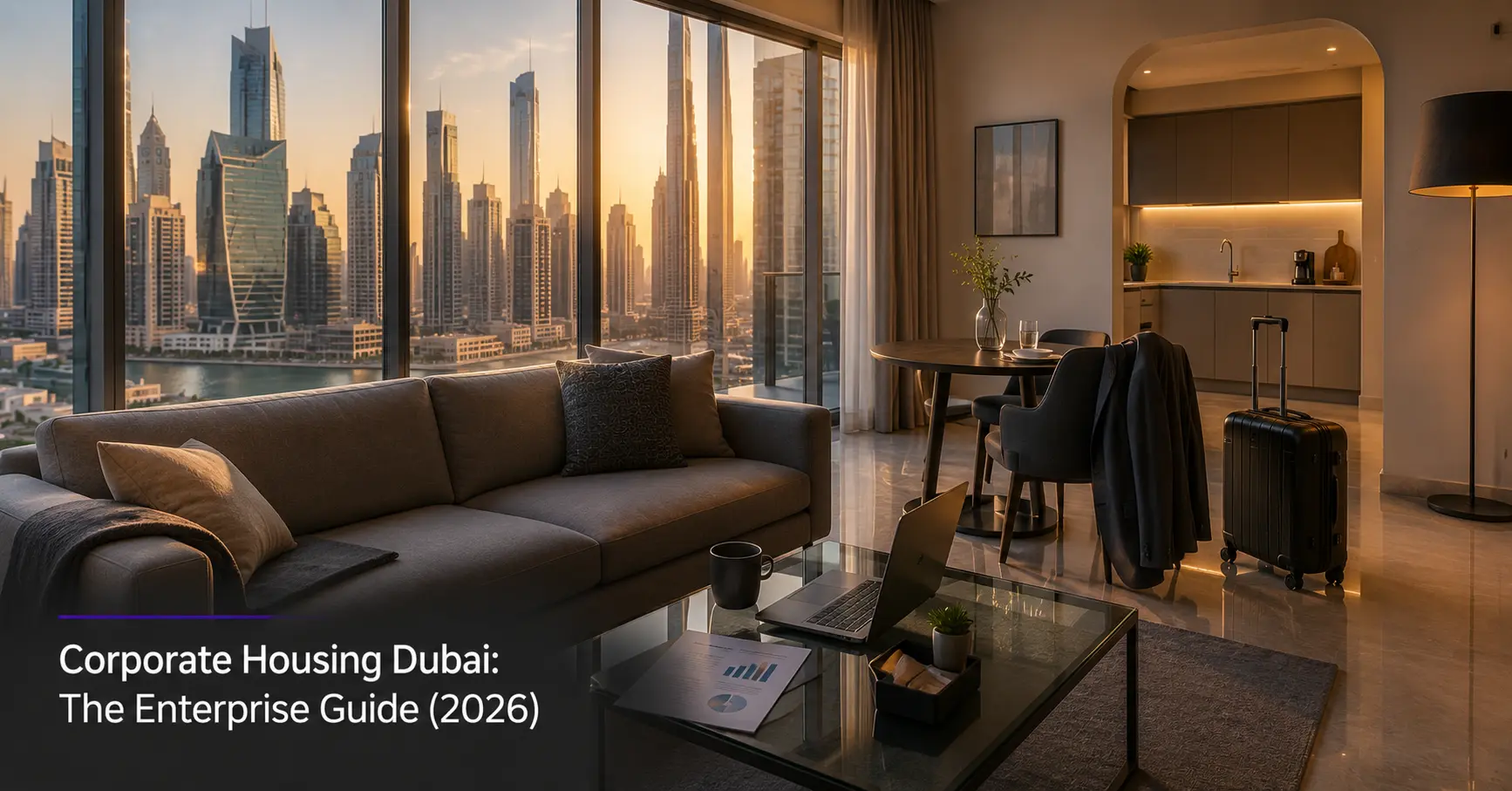
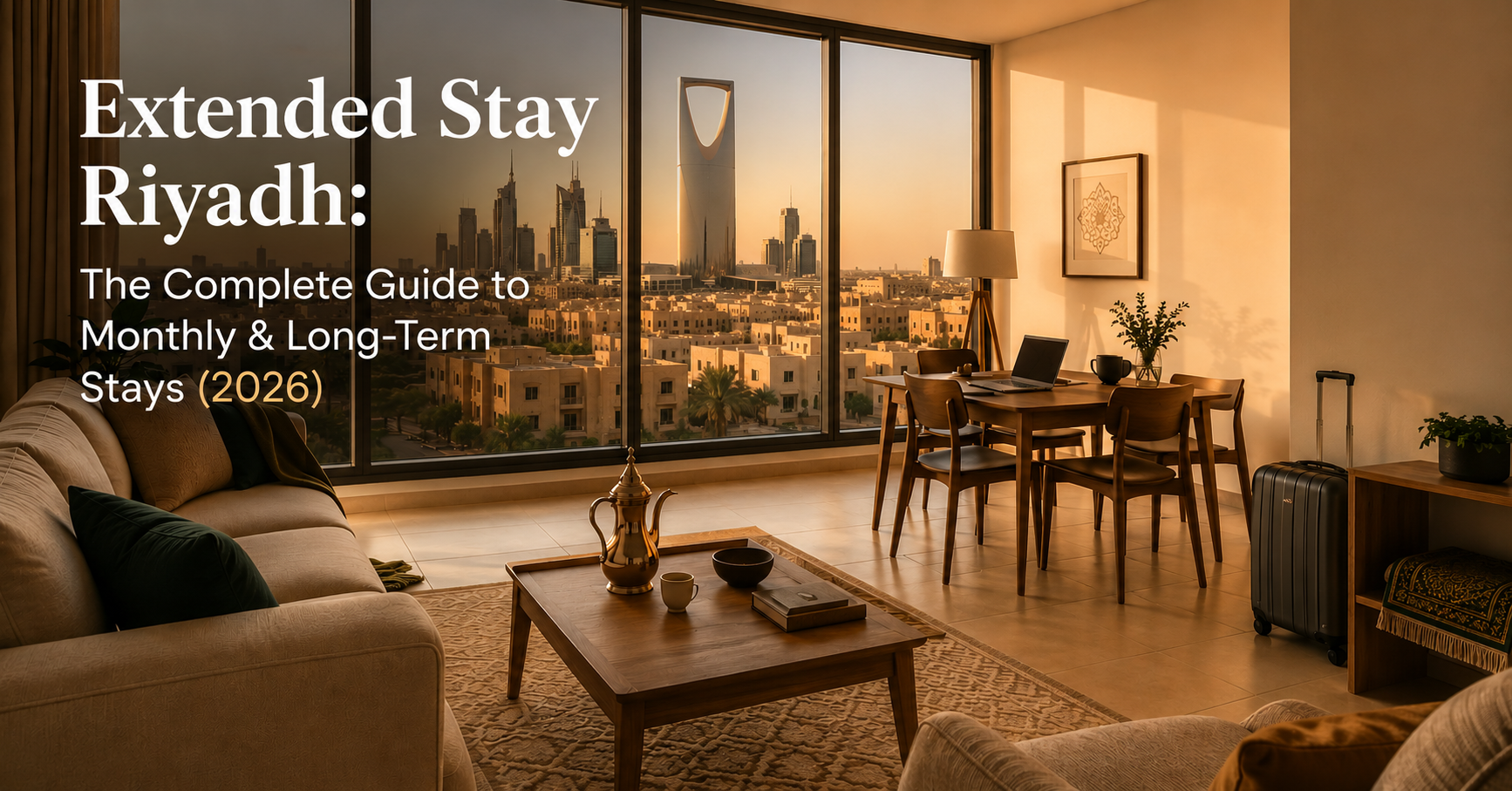
Browse monthly stays in Dubai and book in minutes. Moving for a job rather than working remotely? Our relocation accommodation guide covers the first 90 days. Bringing a team? See corporate housing in Dubai. Heading elsewhere in the region? We cover extended stays in Riyadh and Abu Dhabi too.
Frequently Asked Questions
Is there a digital nomad visa for Dubai?
Yes. There are two routes. The federal virtual work residence visa, issued through the ICP, requires proof of at least USD 3,500 per month. Dubai’s own Virtual Working Programme, listed on the UAE government portal, requires USD 5,000 per month and states a fee of USD 287 per person. Both are valid for one year and both allow you to sponsor family members.
How much income do you need for the Dubai digital nomad visa?
USD 3,500 per month for the federal virtual work residence visa, or USD 5,000 per month for Dubai’s Virtual Working Programme. Employees prove it with an employment contract valid for at least a year, a recent salary slip and three months of bank statements. Company owners show proof of ownership for at least a year plus three months of company bank statements.
Can I rent an apartment in Dubai without a residence visa?
You can book a hotel apartment, a licensed serviced apartment or a licensed furnished monthly rental with just your passport, and no UAE residency is needed. You cannot sign a standard annual residential lease, because Ejari registration requires a valid Emirates ID and DEWA will not connect utilities without an Ejari number. This is why most new arrivals spend their first one to three months in a furnished monthly stay.
How long should a digital nomad book accommodation for on first arrival?
Plan for at least one month, and expect to need four to eight weeks in total if you intend to move onto an annual lease. That is how long the sequence of medical test, biometrics, residence permit and Emirates ID realistically takes. Booking a monthly stay you can extend is safer than booking a short stay you have to scramble to replace.
How much does it cost to live in Dubai as a digital nomad?
A lean month runs around AED 7,000 (about USD 1,900) including a studio outside the centre, a day-pass coworking subscription, food and transport. A comfortable month is closer to AED 14,300 (about USD 3,900). A premium month in Downtown or Marina with a dedicated desk and taxis everywhere is around AED 28,200 (about USD 7,700). Numbeo put single-person costs excluding rent at AED 4,130.80 as of 24 July 2026.
What does a furnished monthly apartment cost in Dubai?
A studio runs roughly AED 4,000–11,000 a month, a one-bedroom AED 7,000–18,000, and a two-bedroom AED 9,000–22,000. Those rates normally include electricity, water, internet and housekeeping. Longer bookings usually attract lower monthly rates, so a three- or six-month stay often costs less per month than a single month.
Do digital nomads pay tax in Dubai?
The UAE does not levy personal income tax, so a remote employee on a foreign payroll pays nothing on that salary in the UAE. Freelancers with a UAE licence only enter the corporate tax regime once business turnover exceeds AED 1,000,000 in a calendar year, and then pay 0% on taxable income up to AED 375,000 and 9% above it. VAT is 5%. Your home country may still tax you, so check your own position.
Which area of Dubai is best for digital nomads?
JLT is the strongest all-round choice: on the metro, walkable, café-dense and cheaper than Marina or Downtown. Business Bay and Downtown suit anyone with client meetings in DIFC. Dubai Marina and JBR suit a more social lifestyle. JVC, Dubai Silicon Oasis and Al Barsha offer the best value for longer stays. Deira and Bur Dubai are the cheapest and closest to the airport.
How fast is the internet in Dubai?
The UAE ranked first in the world for median mobile download speed at 642.86 Mbps in Ookla’s May 2026 Speedtest Global Index, and third globally for fixed broadband. Home packages run from about AED 229 a month for 5G home wireless to AED 429 for 1 Gbps fibre. In a furnished monthly stay, internet is normally included in the rate. Ask the operator what speed the specific unit gets.
What does a coworking desk cost in Dubai?
A hot desk typically costs AED 800–1,500 a month, a dedicated desk AED 1,200–2,200, and a private office AED 2,500–3,500. Day passes run AED 75–150. Credit-based subscriptions that work across cafés, hotels and workspaces start around AED 490 a month. DIFC and Downtown locations cost roughly 30–40% more than emerging districts.
Can I bring my family on a Dubai remote work visa?
Yes. Both the federal virtual work visa and Dubai’s Virtual Working Programme allow you to sponsor your spouse and children, and dependent children can enrol in UAE schools. Each dependant needs their own health insurance, and those aged 18 and over need a medical fitness test.
Is Dubai good for digital nomads in summer?
It is manageable if you choose the right building. From June to September outdoor life largely stops during daylight hours, so pick a tower connected to a metro station or a mall. JLT, Downtown, Business Bay, Al Barsha and Deira all offer this. Monthly rates and availability both improve over summer, so the value is real if you can plan around the heat. Budget for cooling: chiller charges on a one-bedroom can reach AED 900–1,400 a month in July and August unless they are included in your monthly rate.