An extended stay is a furnished home you rent for a month or longer. It could be a serviced apartment, a hotel apartment, or a privately managed rental. The furniture, kitchen, Wi-Fi, utilities, and regular cleaning are already included in one monthly price, so you move in and start living without setting anything up yourself.
It sits between two familiar options. On one side, there’s a hotel room that you pay for by the night. On the other, there’s a traditional lease that locks you in for a full year, asks for a deposit, and leaves you to arrange furniture and utilities on your own. An extended stay gives you the comfort and space of a real apartment with the simplicity and flexibility of a hotel.
The idea has been around for decades, but it has grown fast in recent years. More people work remotely, more companies send teams on projects that last months rather than weeks, and more families want a place to settle before committing to a long lease in a new city. All of these people need something better than a hotel room but more flexible than a yearly contract. That is exactly what an extended stay is for.
On this page
- How an extended stay works
- The three types of extended stay homes
- What is included
- How it compares to a hotel
- How it compares to a short term rental
- How it compares to an annual lease
- Who stays long term and why
- How much it costs
- How to choose the right one
- How to book
- Frequently asked questions
How an extended stay works
The process is simple. You search for a furnished home in the city you need, filter by your dates and apartment size, compare the monthly prices, and book. When you arrive, the apartment is ready: the bed is made, the kitchen is stocked with basics, the internet is connected, and someone is available if anything needs fixing.
You pay one monthly rate. That rate almost always covers utilities, Wi-Fi, and regular cleaning, so you are not juggling separate bills or figuring out how to set up electricity in a new country. Most extended stay homes have a minimum booking of 30 nights, and many offer better rates the longer you commit. If your plans change, you can usually extend or shorten your stay without paying heavy penalties.
There is no deposit in most cases, no real estate agent fee, and no furniture to buy. You bring your suitcase, and the rest is already there.
The three types of extended stay homes
Not all extended stays are the same. There are three main types, and each one suits a different situation.
Hotel apartments are run by hotel brands. You get a furnished apartment with a kitchenette, plus the services you would expect from a hotel: a front desk, housekeeping, a gym, a pool, and sometimes breakfast. The quality is consistent because a brand manages everything. This is the right choice if you want hotel level service but more space than a standard room. Brands like Fraser Suites, Marriott (Element), Rotana, and Radisson run hotel apartments in cities across the Middle East and beyond.
Serviced apartments are fully furnished homes with a proper kitchen, a living area, and weekly or biweekly cleaning. They feel more like your own apartment than a hotel. You have more privacy, more space, and more independence, but someone still takes care of maintenance and housekeeping. This is the most popular option for stays of one month and up, especially for families and professionals who want to settle into a routine.
Furnished monthly rentals are private apartments that come with furniture and bills included, rented by the month. They give you the most space and the lowest price, but with the least service. No front desk, no daily housekeeping. This works well when you already know the neighborhood you want to live in and prefer a quieter, fully independent lifestyle.
| Type | Best for | Service level | Privacy | Typical price |
| Hotel apartment | Business, short to medium stays | High (front desk, gym, pool) | Medium | Higher |
| Serviced apartment | Families, 1 to 6 month stays | Medium (cleaning, maintenance) | High | Mid range |
| Furnished rental | Longer stays, independence | Lower (self managed) | Highest | Lower |

What is included in an extended stay
One of the biggest advantages of an extended stay is that most of what you need is already covered. Here is what a typical furnished stay includes:
Always included: Furniture (bed, sofa, dining table, storage), a kitchen or kitchenette with basic equipment (pots, pans, plates, cutlery), Wi-Fi, electricity, water, and air conditioning.
Usually included: Regular cleaning (weekly or biweekly), fresh towels and linens, building security, and access to shared amenities like a gym or pool.
Sometimes included, sometimes extra: Parking, laundry, premium Wi-Fi speeds, daily housekeeping, and breakfast.
The key thing to check before you book: what exactly does the monthly price cover? A good listing will spell this out clearly. If it does not, ask before you commit. The point of an extended stay is one predictable monthly number, not a surprise bill at the end.
How an extended stay compares to a hotel
If you are staying somewhere for a week, a hotel makes perfect sense. But once your stay stretches past two or three weeks, a hotel starts to feel expensive and limiting.
A hotel room is designed for sleeping, not living. You eat every meal out (or order room service), your workspace is usually a small desk, and your clothes live in a suitcase. Over 30 days, the nightly rate adds up to something much higher than a monthly apartment rate for similar quality.
An extended stay apartment gives you a kitchen, a living room, and enough space to spread out and work comfortably. You can cook when you want, do your laundry, and have a real routine. The monthly rate is almost always significantly lower than 30 hotel nights.
| Extended stay | Hotel room | |
| Space | Living room, bedroom, kitchen | One room |
| Kitchen | Full kitchen or kitchenette | Usually none |
| Cost over 30 days | One monthly rate (lower) | 30 nightly rates (higher) |
| Laundry | In unit or on site | Paid hotel service |
| Routine | Feels like home | Feels like travel |
| Flexibility | Stay months, extend easily | Book night by night |
| Best for | Stays of a month or more | A few nights to two weeks |
For a deeper look at how this plays out in practice, see our comparison of serviced apartments vs hotels in Dubai.
How an extended stay compares to a short term rental
Short term rentals (like those on Airbnb or similar platforms) are another option for stays of a few weeks. They overlap with extended stays in some ways, but there are real differences.
A short term rental is usually someone’s private property listed on a marketplace. Quality, cleanliness, and accuracy vary because each listing is managed by a different person. You might get a perfect place, or you might arrive and find it does not match the photos. Service is minimal: if the dishwasher breaks, you are messaging an individual host, not calling a maintenance team.
An extended stay through a managed platform or a hotel brand gives you more consistency. The apartments are professionally maintained, the pricing is transparent, and there is real support if something goes wrong. You also avoid the booking fees that short term rental platforms often charge on top of the listed price.
| Extended stay | Short term rental (Airbnb, etc.) | |
| Quality consistency | Managed, predictable | Varies by host |
| Service and support | Professional maintenance team | Individual host |
| Pricing | Clear monthly rate, all in | Nightly rate + fees + cleaning |
| Minimum stay | Usually 30 nights | Often 1 night |
| Trust and accountability | Brand or platform backed | Host dependent |
How an extended stay compares to an annual lease
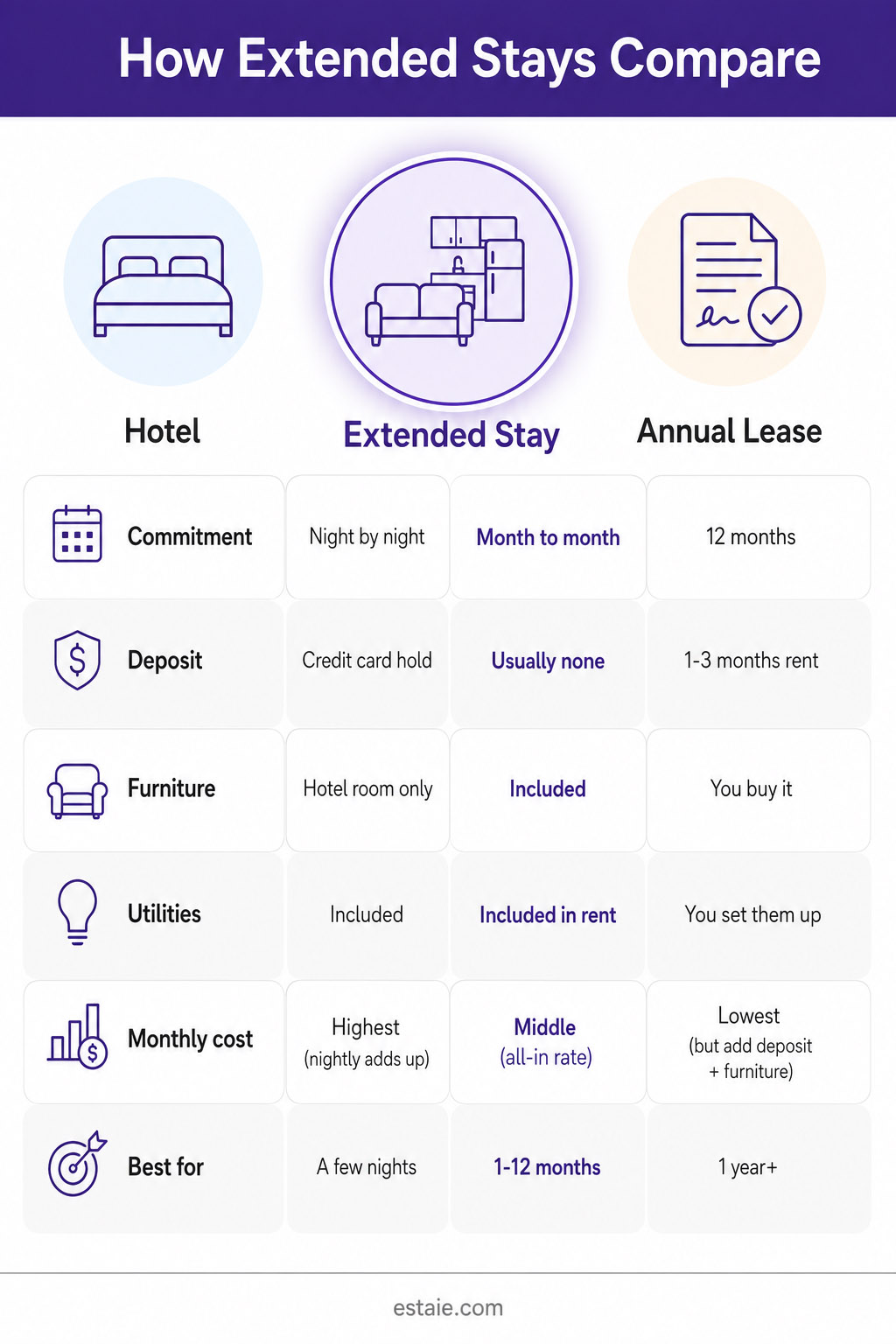
In many cities, the traditional way to rent an apartment is to sign a 12 month lease, pay a deposit (often two months of rent), hire a real estate agent, set up utility accounts, and buy your own furniture. This makes sense if you are settled and plan to stay for years. But if you are on a work assignment, relocating, or testing a new city, a year long commitment is risky and expensive upfront.
An extended stay removes all of that friction. No deposit, no agent fee, no furniture shopping, no utility setup. You book for the months you need and leave when you are done. The monthly rent is higher than an unfurnished annual lease, but when you add up the deposit, the furniture costs, the agent fee, and the utility setup, the total cost of a short to medium stay is often lower with a furnished monthly apartment.
| Extended stay | Annual lease | |
| Commitment | Month to month | 12 months |
| Deposit | Usually none | 1 to 3 months rent |
| Furniture | Included | You buy it |
| Utilities | Included in rent | You set them up |
| Agent fee | None | Often 5% of annual rent |
| Move in time | Same day | Weeks (paperwork, furnishing) |
| Best for | 1 to 12 months | 1 year or more |
Who stays long term and why
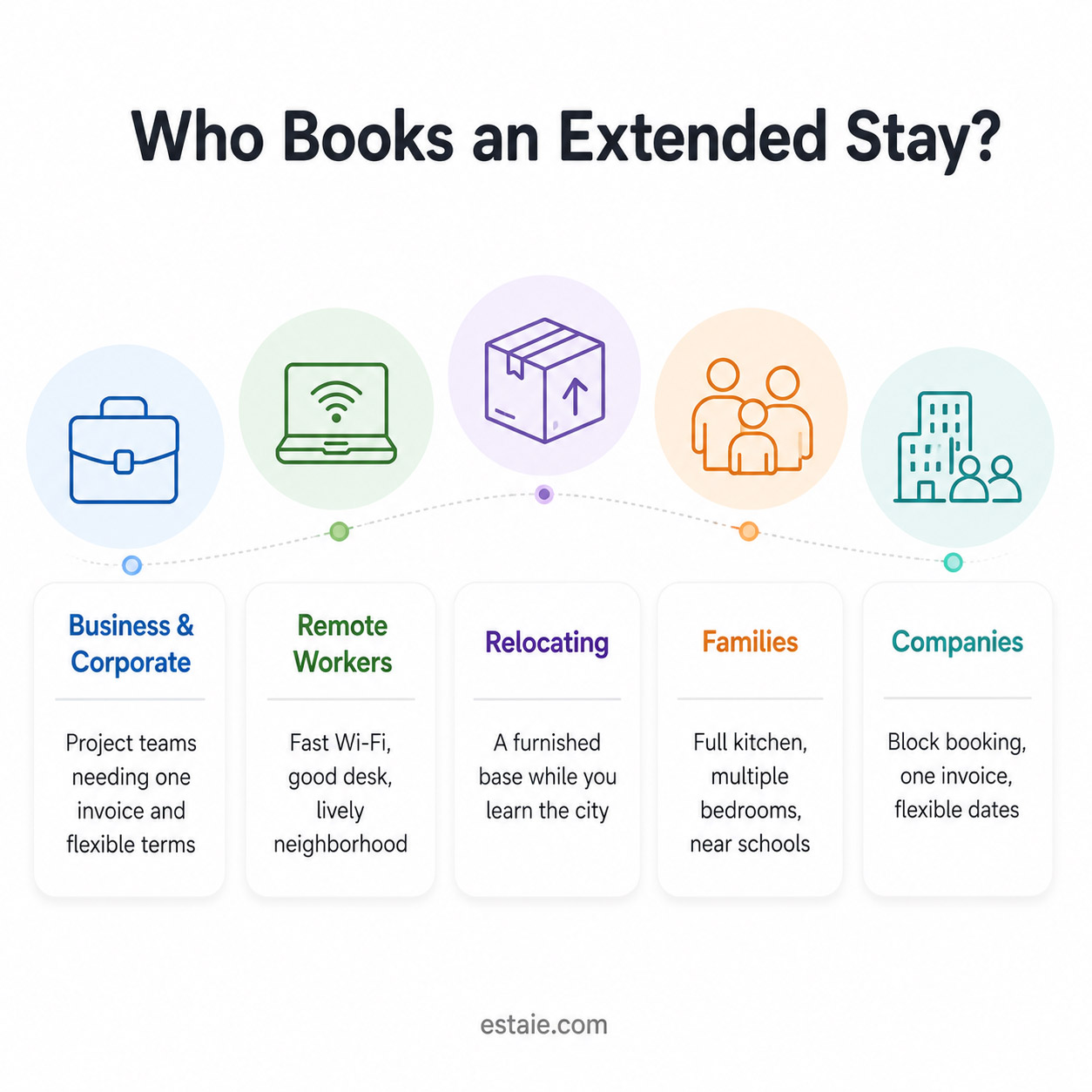
Extended stays are not for one type of person. The same apartment might be booked by a consultant one month and a family the next. Here is who tends to use them and what they care about most.
Professionals on work assignments. A company sends you to a new city for three months, six months, or a year. You need somewhere comfortable near the office, with a kitchen and a workspace, and your employer wants one clean invoice. This is the single biggest group of extended stay guests worldwide.
Remote workers and freelancers. You can work from anywhere, and you want to live in a new city for a while without signing a lease. Fast Wi-Fi, a good desk setup, and a neighborhood with life around it matter more than a front desk or a pool.
People relocating. You have taken a new job or moved your family to a new country. You need a base for the first one to three months while you find schools, learn the neighborhoods, and choose where to settle permanently. A furnished apartment lets you arrive and live normally from day one while you figure everything out.
Families. Moving with children takes time, and kids need stability. A furnished family apartment near schools and parks gives everyone space to breathe and a real kitchen to cook in, without the pressure of making a permanent decision in week one.
Companies booking for teams. When a business is sending five or ten people to the same city, individual hotel rooms get expensive fast. A block of serviced apartments with one invoice and flexible dates is simpler, cheaper, and better for team morale. See how corporate housing for companies works on estaie.
How much does an extended stay cost
Prices depend on the city, the neighborhood, the apartment size, and how long you book. But the pattern is consistent everywhere: extended stays cost less per month than the equivalent hotel, and more per month than an unfurnished annual lease (though the total cost for a short stay is often lower because you avoid deposits, furniture, and setup costs).
As a rough guide, a furnished studio in a major city typically starts from the equivalent of $600 to $1,000 per month. A one bedroom runs $900 to $2,500, and a two bedroom $1,300 to $4,000. Premium neighborhoods and luxury serviced apartments sit above those ranges. Budget areas and longer commitments bring prices down.
The exact numbers vary a lot by market. Gulf cities like Dubai and Riyadh have very different price levels, and even within the same city the gap between a budget district and a premium waterfront can be three or four times. That is why we break the numbers down by city in our dedicated guides:
See real prices in your city:
- Extended Stay Dubai (prices in AED, 7 areas compared)
- Extended Stay Riyadh (prices in SAR, 7 districts compared)
If you want the full picture beyond rent, our cost of living in Dubai guide breaks down groceries, transport, dining, and everything else.
The key cost advantage is predictability. Your monthly rent covers utilities, internet, and cleaning, so there are no surprise bills. Over a stay of three months or more, this usually works out to at least 30% less than booking the same quality hotel night by night. And unlike a traditional lease, there is no upfront deposit, no agent fee, and no furniture to buy.
How to choose the right extended stay
There is no single best option. The right one depends on four things:
How long you are staying. For one to two months, a hotel apartment gives you the most convenience. For three months or more, a serviced apartment or furnished rental will save you money and feel more like home.
Who you are traveling with. Solo professionals can be comfortable in a studio or one bedroom. Families need two or three bedrooms, a full kitchen, and a family friendly building. Ask about noise levels, play areas, and nearby schools.
Where you need to be. Location matters more than amenities in most cases. An apartment near your office or your children’s school will make your daily life easier, even if it is slightly smaller or has fewer extras than one across the city.
What matters most to you. Some people want hotel style service and a gym. Others want a quiet apartment with a great kitchen and fast internet. Be honest about what you actually use every day, not what sounds nice in a listing.
Once you have narrowed it down, compare two or three options on a like for like basis: total monthly cost (including everything), location, apartment size, and cancellation flexibility.
How to book an extended stay
- Start with your dates and city. Use a platform that shows monthly rates, not just nightly ones.
- Filter by what matters. Apartment size, neighborhood, budget, and what is included.
- Compare the total monthly price. Make sure you are comparing all in costs, not base rates with hidden fees on top.
- Read the terms. Check the minimum stay, cancellation policy, and what happens if you want to extend.
- Book and move in. With a furnished, all inclusive apartment, you can arrive and start your life the same day.
If you are looking at the Gulf region, our comparison of booking platforms in Saudi Arabia and the UAE breaks down the main options.
Estaie is built for exactly this. You can search across hotels, serviced apartments, and managed homes, see one clear monthly price, and book without deposits or paperwork. See how estaie works for guests or start browsing stays.

Frequently asked questions
What does “extended stay” mean?
An extended stay is a furnished apartment, hotel apartment, or managed rental that you book for a month or more. The rent includes furniture, utilities, Wi-Fi, and regular cleaning, so you pay one monthly price and live like you are at home.
How long can you stay?
Most extended stays start at 30 nights. You can usually book for up to a year, and many properties offer lower monthly rates for longer commitments. If your plans change, you can often extend with a short notice.
Is an extended stay cheaper than a hotel?
For any stay longer than two to three weeks, yes. A monthly rate for a serviced apartment is almost always lower than 30 separate hotel nights at the same quality level. You also save on meals because you have a kitchen.
Is an extended stay the same as a serviced apartment?
A serviced apartment is one type of extended stay. The term “extended stay” also includes hotel apartments and furnished monthly rentals. They all share the same idea (a furnished home for longer stays) but differ in service level, price, and feel.
Do you need a visa or residency to book an extended stay?
For hotel apartments and licensed serviced apartments, a passport and valid entry visa are usually enough. You do not need residency. For a private residential lease, residency may be required depending on the country.
Are bills included in the price?
In most cases, yes. Electricity, water, internet, and air conditioning are typically included in the monthly rate. Always confirm this before you book, because some private rentals may charge utilities separately.
Can families book an extended stay?
Yes. Many extended stay properties have two and three bedroom apartments with full kitchens, living areas, and access to pools and play areas. They are popular with families who are relocating or visiting for an extended period.
What is the difference between an extended stay and an Airbnb?
An Airbnb is a short term rental managed by an individual host. Quality and service vary. An extended stay through a managed platform or hotel brand gives you more consistency, professional support, transparent pricing, and no surprise booking fees.